Approve a custom swim-backpack sample only when it matches the frozen design evidence for structure, access, representative-item fit, branding and packout. Record each check as accept, revise or hold for a separately defined test. A visual or handling review can confirm what is present and how the sample operates; it cannot prove waterproofing, strength, durability, colourfastness or any other performance result.
Use one evidence pack throughout the review: the current specification revision, approved artwork, colour references, compartment drawing, buyer-provided packing list, label files and packaging brief. Photograph the same views before and after packing, and describe every mismatch against a named reference rather than relying on “looks good.”
1. Freeze the review evidence before opening the sample
Write down the specification and artwork revisions used for the inspection. Keep the physical sample, colour reference, compartment drawing and packaging brief together during the review. If two documents conflict, stop that check and request one controlling revision; do not choose the more convenient version.
One swimming-program procurement document provides a useful example of why samples matter: it calls for team choice of model and style, custom colours and logo, and equipment samples before ordering deadlines. That is one documented procurement example, not a universal rule. Your approval record should follow the evidence agreed for your own project.
2. Define three clear outcomes
Use the same outcome language for every inspection line:
- Accept: the observed feature matches the frozen evidence for this sample review.
- Revise: the observed feature differs from the frozen evidence and needs a documented correction.
- Hold for a separate test: the question cannot be answered by visual inspection or ordinary handling.
For a revision, record the observed condition, the controlling drawing or artwork, the requested correction and the evidence required at the next review. Avoid invented tolerances, AQL levels or pass/fail thresholds. Those belong only in a separately approved quality plan.
3. Check silhouette, colour and visible material direction
Start with the empty bag. Compare its overall shape, panel arrangement, colour placement and visible ripstop surface with the approved evidence. Photograph the front, back, both sides, base and opening under consistent lighting.
Record only what can be observed. A visible ripstop pattern does not establish denier, coating, tear strength, water resistance or durability. If those properties matter, identify the material document or separate test evidence required before a performance decision.
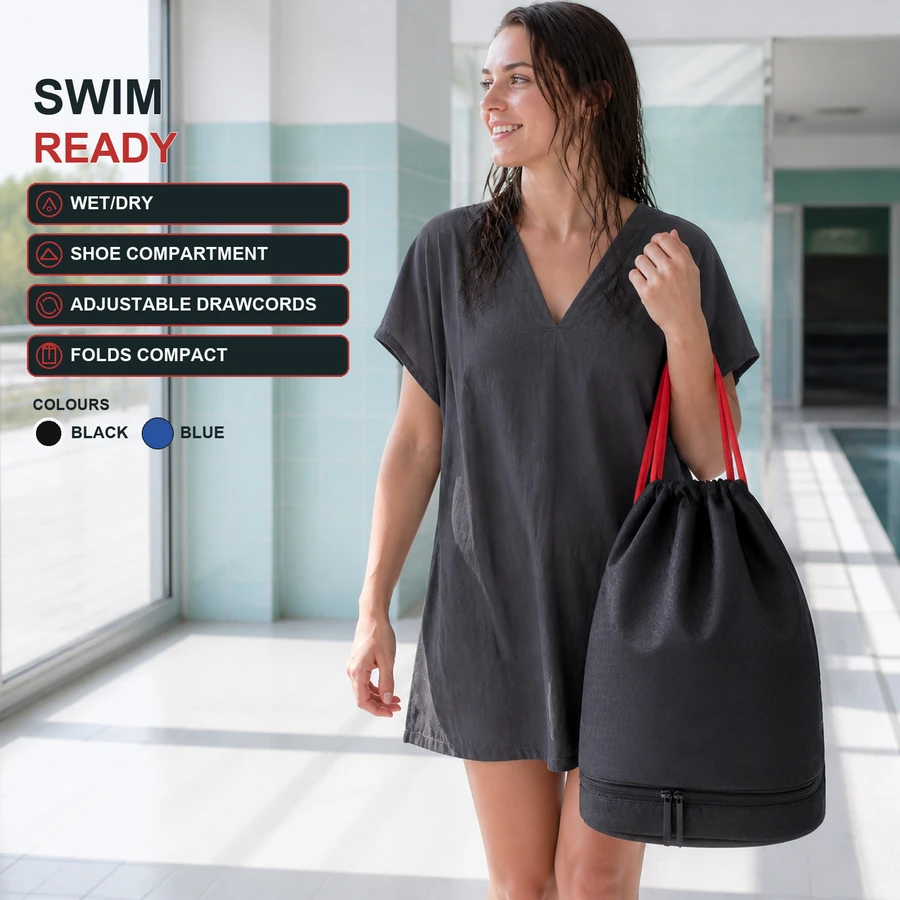
The launched HENRY drawstring swimming backpack is a relevant construction reference because its verified fields include black ripstop nylon, separate wet/dry compartments, a zipped bottom shoe compartment, a drawstring closure, adjustable shoulder straps, a nylon handle and collapsible construction. These fields define the inspection scope; they do not prove containment, load or wear performance.
4. Inspect the gathered opening, drawcord path and handle
Open and close the main opening several times without loading the bag. Observe whether the fabric gathers evenly, whether the drawcord follows the intended route and whether the cord ends, adjusters and attachment points match the approved drawing. Check that the shoulder routing does not block the main opening or the handle.
Wear or carry the sample only as needed to observe strap adjustment and access. Do not convert that handling check into a comfort, load-bearing or strength claim. Record interference, twisting, unexpected contact or difficult access as observations for revision.
5. Review compartment access before and after packing
Open the main storage, each wet/dry section and the bottom shoe compartment in a consistent order. Check zipper direction, opening geometry, divider placement and whether one opening obstructs another. Photograph the empty arrangement before adding items.
“Wet/dry” is an organization direction. It does not mean the divider, seams or zipper are waterproof, leakproof or sealed. If containment matters, place that question in a separately approved material and test plan rather than marking it accepted during this workflow.
6. Use a buyer-controlled representative packing list
Swim England's public packing guidance includes swimwear, towels, a cap, goggles, toiletries, poolside shoes and a water bottle. Select only the items relevant to the intended program, then use the same buyer-provided set for every sample revision.
During packing, record:
- which item is assigned to each compartment;
- whether the intended opening remains accessible;
- whether a filled lower compartment interferes with the main storage;
- whether small items stay in their specified pockets;
- whether the filled shape still exposes the intended branding panel;
- whether the planned packaging can accommodate the folded or collapsed bag.
This is a fit-and-access observation, not a capacity, load, drainage or durability test. Do not add a volume or weight claim unless it is supported by the final written specification and current evidence.
7. Match branding, labels and packout to approved files
Compare logo content, placement, orientation, size reference and colour reference with the approved artwork. Check visible labels against the supplied label files and confirm that packaging components match the approved packout brief.
Record objective differences such as wrong placement, missing content, reversed orientation or an unapproved packaging component. Do not assess colourfastness, print durability or regulatory compliance through appearance alone. Those questions require their own approved evidence.
8. Record visible workmanship without claiming performance
Inspect seam paths, stitch continuity, loose thread ends, panel alignment, zipper installation, drawcord routing and attachment symmetry. Describe the exact location and visible condition, supported by a photograph.
Visible workmanship review can identify a correction; it does not establish seam strength, abrasion resistance, zipper life or production consistency. If a buyer needs a quantified result, the method, sample size and acceptance threshold must be defined separately before testing.
9. Close every mismatch before the next decision
A useful discrepancy entry contains four parts:
- the observed condition and location;
- the controlling specification, drawing or artwork reference;
- the agreed disposition: accept, revise or separate test;
- the evidence required for closure, such as an updated drawing, corrected sample or approved test result.
Do not approve around an unresolved conflict. If a correction changes compartment geometry, artwork, material direction or packaging, update the controlling evidence before reviewing the next sample.
10. Build the final approval handoff
The handoff should include the frozen evidence list, completed inspection record, annotated photographs, packing list, unresolved separate-test questions and the final disposition for every mismatch. Keep development choices conditional on artwork review, material selection, sampling, MOQ and final written specifications.
For earlier-stage decisions, use the swim-bag architecture comparison, the gym-bag tech-pack RFQ checklist and the team sports backpack compartment guide. The custom gym and sports bags overview provides adjacent format context. Buyers can send a frozen brief and annotated review through the custom bag inquiry form.
Frequently asked questions
Can a wet/dry compartment be approved as waterproof during this review?
No. This workflow can confirm the compartment layout and access. Waterproofing, leakage and seam performance require separately defined materials, methods and current test evidence.
How should the bottom shoe compartment be checked?
Use the buyer-provided representative footwear, observe access and interference with the main storage, and compare the compartment geometry with the approved drawing. Do not turn that observation into an unsupported capacity or durability claim.
Does one approved sample set the production acceptance standard?
No. The sample and its review evidence can freeze design intent. Production tolerances, sampling rules and test thresholds must be defined in a separate approved quality plan.
What should accompany a revised sample?
Send the updated specification or drawing, corrected artwork where relevant, a disposition for each prior mismatch and new photographs showing the changed areas. Reuse the same representative packing list so access observations remain comparable.
Sources and product references
- Swim England, How to pack for swimming, representative packing items, accessed August 26, 2026.
- Auburn University Procurement & Business Services, mirrored by SEAMS, Swimming & Diving Equipment RFP, one procurement example for model/style, team colours/logo and advance samples, accessed August 26, 2026.
- HENRY GOOD, drawstring swimming backpack, verified structure reference.