Choose the architecture from the packing routine, not from a generic claim that one bag type is “better.” A separated drawstring swim backpack is the stronger first sample direction when footwear and selected damp items need defined zones. A mesh swim bag is the clearer first direction when buyers want an open main body with specified accessory pockets. Neither architecture, by itself, proves drying, drainage, containment, load or durability performance.
For an RFQ, turn that decision into a packing list, compartment map, opening plan, carry brief and sample checks. This keeps the comparison useful without assuming results that only the final materials, construction and agreed tests can establish.
Start with the items and handling routine
List what the user actually carries and when each item is accessed. Swim England's public packing guidance includes swimwear, towels, a cap, goggles, toiletries, poolside shoes and a water bottle. A club or brand brief may add training aids, team apparel, credentials or personalized items.
Then classify the load:
- items that should remain easy to see;
- footwear or accessories that need a defined zone;
- small items that need a zipped pocket;
- items that should not press against delicate gear;
- branding panels that must stay visible when the bag is filled.
This exercise is more useful than starting with an unqualified request for “large capacity” or “quick drying.”
Compare the two architectures
| RFQ question | Separated drawstring backpack direction | Mesh swim bag direction |
|---|---|---|
| How is the load organized? | Main storage plus specified separated zones | Open mesh main body plus specified accessory pockets |
| What should the first sample prove? | Compartment access, interference and opening sequence | Pocket placement, opening access and how the filled shape behaves |
| What must the buyer define? | Lining, divider construction, shoe-zone opening and drawcord routing | Mesh specification, reinforcement, pocket construction and closure layout |
| What must not be assumed? | Waterproofing, leak containment, repellency or sealed separation | Drying speed, drainage rate, strength, snag resistance or durability |
The table is a specification framework, not a performance ranking. A useful comparison asks what each sample must demonstrate for the intended program.
When a separated drawstring backpack is the better first sample
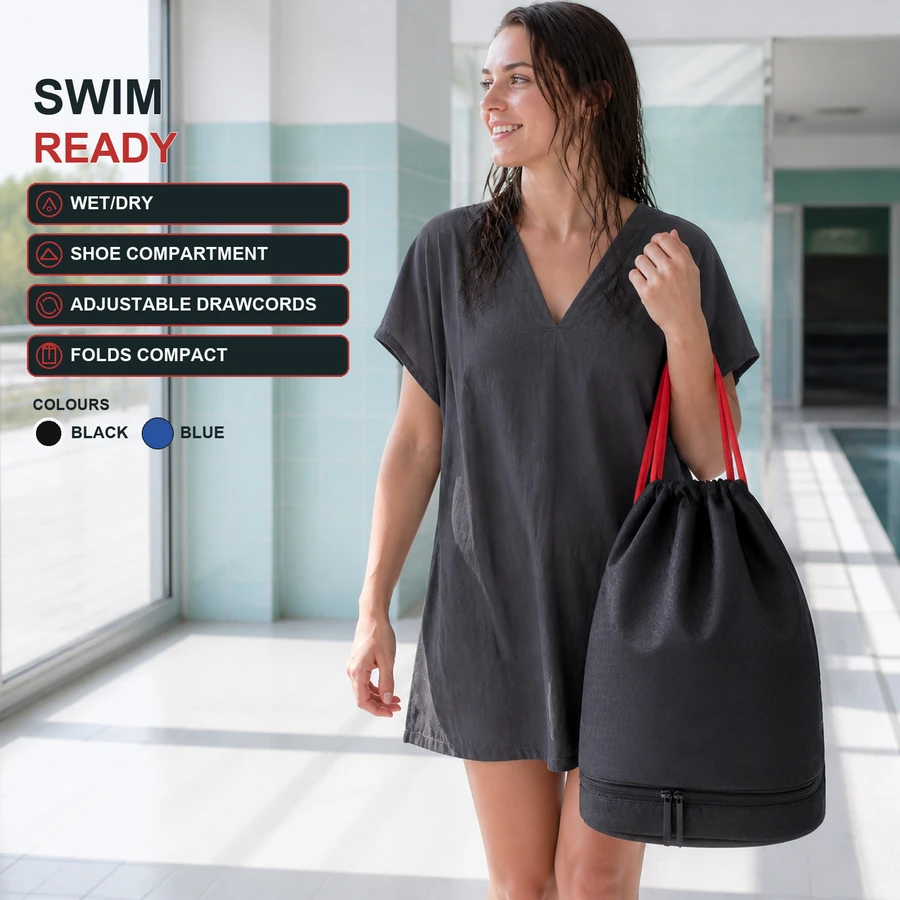
Use this direction when the brief depends on distinct storage zones. The launched HENRY drawstring swimming backpack provides a verified reference with black ripstop nylon, separate wet/dry storage, a zipped bottom shoe compartment, adjustable drawcord shoulder straps and a nylon handle.
For a new project, specify which items belong in each zone and whether a full lower compartment may reduce the usable main space. Check that the shoe opening, main opening and drawcord path do not obstruct one another. “Wet/dry” describes the intended organization; it is not a promise of waterproof or leakproof isolation.
When a mesh swim bag is the better first sample
Use a mesh direction when the buyer wants an open-body equipment format and can define the required external organization. The launched HENRY 40 L mesh swim backpack is a verified reference with a mesh body, drawstring format and bottle, front-zip and interior-zip pocket directions. A second 40 L mesh swim gear backpack provides a different equipment-led layout with exterior accessory and bottle storage.
These references confirm available layouts, not universal mesh performance. The RFQ should identify the mesh specification, edge binding, reinforcement locations, pocket materials, opening dimensions and intended contents. Drying, drainage, snagging, load and wear outcomes require agreed sample methods rather than marketing shorthand.
Convert the choice into a sample brief
A concise B2B brief should include:
- Packing list: representative gear and the quantity of each item.
- Architecture: separated drawstring or mesh-body direction, with a marked compartment map.
- Target dimensions: measured around the intended load, including opening dimensions.
- Material direction: shell or mesh, lining, binding, reinforcement and hardware for development review.
- Carry system: drawcord or shoulder-strap construction, handle position and intended carry routine.
- Branding: vector artwork, placement dimensions, color references, labels and packaging direction.
- Sample checks: access, compartment interference, filled shape, stitching, hardware operation, artwork and pack-out.
One published swimming-program procurement document illustrates why this discipline matters: it specifies team choice of model and style, team colors and logo, and samples in advance of ordering deadlines. That example supports early sample review; it does not set a universal procurement rule for every buyer.
Review both samples with the same method
If two architectures remain viable, pack both with the same representative load. Photograph the same views, open every compartment in the same sequence and record changes against the same checklist. Compare access and layout against the brief, not against vague claims.
Freeze the selected direction with a compartment drawing, material list, artwork set, color references, labels, packaging and approved sample notes. Customization remains conditional on artwork review, material selection, sampling, MOQ and final written specifications.
Use the custom gym and sports bags overview to check adjacent formats. For related planning, see the team sports backpack compartment guide and the wet-gear sports duffel sourcing checklist.
Frequently asked questions
Is a mesh swim bag always better for wet gear?
No. Mesh describes a construction direction, not a guaranteed outcome. Define the intended contents and verify the selected mesh, seams, reinforcement, pockets and filled sample against agreed checks.
Does a separated wet/dry compartment make a bag waterproof?
No. Separation describes layout. Waterproofing, leak containment and seam performance require separately defined materials, construction and tests.
How many pockets should a custom swim bag have?
Use only the pockets supported by the packing and access routine. Each pocket should have a named content, opening size and placement reason.
What should a buyer send with the first RFQ?
Send the packing list, preferred architecture, target dimensions, compartment sketch, material direction, carry requirements, artwork, color references, packaging direction and sample checks. Buyers can share that brief through the custom bag inquiry form.
Sources and product references
- Swim England, How to pack for swimming, representative packing items, accessed August 26, 2026.
- Auburn University Procurement & Business Services, mirrored by SEAMS, Swimming & Diving Equipment RFP, one procurement example for model/style, team colors/logo and advance samples, accessed August 26, 2026.
- HENRY GOOD, separated drawstring swimming backpack, verified layout reference.
- HENRY GOOD, 40 L mesh swim backpack and 40 L mesh swim gear backpack, verified layout references.