A team sports backpack must organize bulky, dirty, delicate and quick-access items without turning the bag into a maze. The best compartment plan starts with the athlete's packing routine, then translates that routine into openings, dividers, reinforcement and carry details.
The HENRY football backpack reference shows a 32 L direction with separate ball and footwear storage. Buyers can use this guide to plan a private-label backpack for football, training or club programs while keeping every performance statement tied to the final sample and specification.
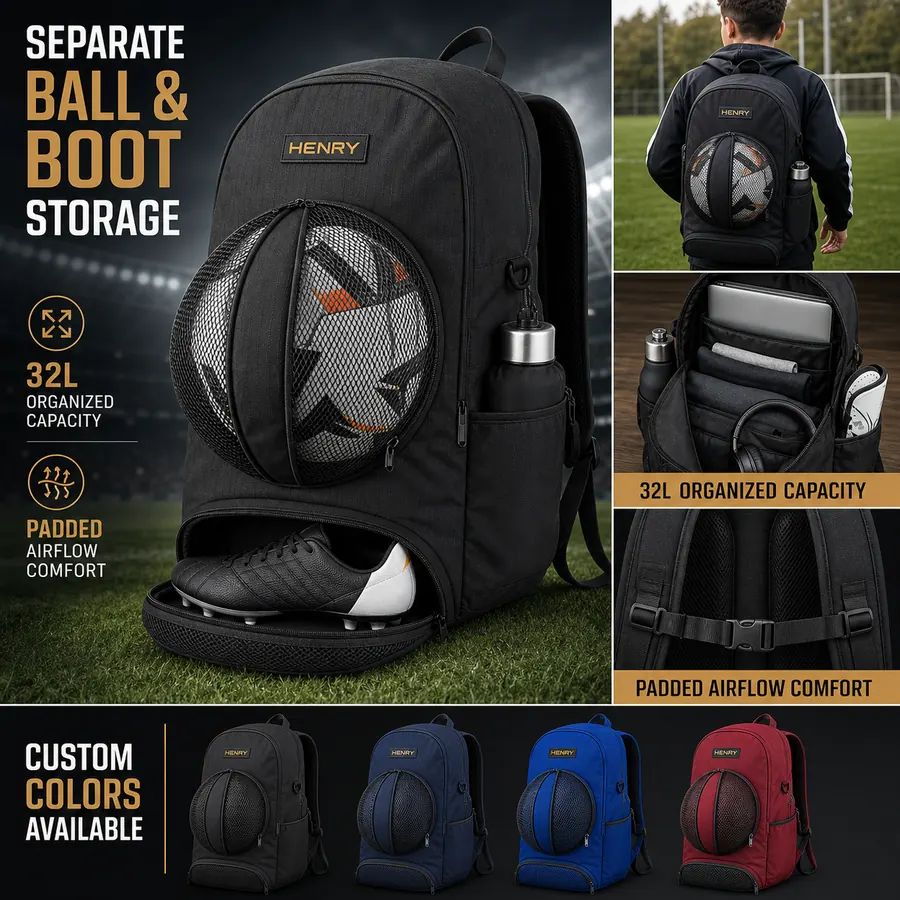
List the carried items first
Write a realistic packing list: ball, footwear, clothing, bottle, towel, small accessories and any school or device items. Mark what is clean, what may be damp or dirty, what needs protection and what must be reached quickly.
This list is more useful than asking for a generic “large-capacity” backpack. It gives each compartment a reason to exist.
Separate ball and footwear zones
Define whether the ball compartment is internal, external or expandable, and how it affects the main volume when full. Do the same for footwear. Check openings with representative items rather than relying only on stated capacity.
If a compartment is intended for damp gear, define the material and construction. Ventilation, containment and drying behaviour are separate questions and require project-specific validation.
Protect the main storage area
Map the remaining space for clothing, accessories and optional device storage. Decide whether dividers are fixed, padded or removable. Confirm that a full ball or shoe zone does not block the main zipper or crush a protected section.
Design quick-access pockets around routines
Small pockets should match the actual items: keys, cards, tape, phone or team credentials. State which opening must be reachable while the backpack is worn or placed beside the field.
Specify carry and stabilization details
Record strap width, padding direction, back-panel construction, top handle and any chest strap. Approve the loaded sample with the intended carrying routine. Load, comfort or durability claims should not be published without defined specifications and agreed tests.
Coordinate team branding
Choose logo locations after pocket seams and reinforcement panels are fixed. Provide vector artwork, placement dimensions and colour references. If player names or numbers vary, define the personalization file format and approval process.
Custom colours and materials remain subject to design review, sampling, MOQ and final specification. A digital team-colour mockup is not a substitute for physical sample approval.
Review the sample as a sequence
Pack the agreed items, operate every opening, carry the bag, place it on the ground and repack it. Check compartment interference, zipper access, handle balance, stitching, labels and branding. Number changes and attach photos to the correct panel or compartment.
Freeze the production record
The approved sample should link to a compartment map, bill of materials, artwork set, colour references, labels and packaging. Keep one stable version number across these files so later changes are visible.
Frequently asked questions
How many compartments should a team backpack have?
Use only the compartments required by the verified packing routine. Extra pockets add construction and can reduce usable space if they are not planned together.
Does a separate footwear pocket keep the rest of the bag clean?
Separation is a layout direction, not an absolute guarantee. Results depend on the final materials, seams, openings and how the backpack is used.
When should personalization be finalized?
After panel dimensions and logo locations are fixed, but before production artwork is released. Define how names or numbers will be supplied and checked.
What belongs in the first RFQ?
Include the packing list, compartment map, target dimensions, material direction, carry requirements, artwork, colour references, packaging and sample checks.
Source and product reference
- HENRY GOOD, Custom Football Backpack with Separate Ball and Boot Compartments, verified 32 L direction with separate ball and footwear storage and conditional customization scope, accessed August 16, 2026.