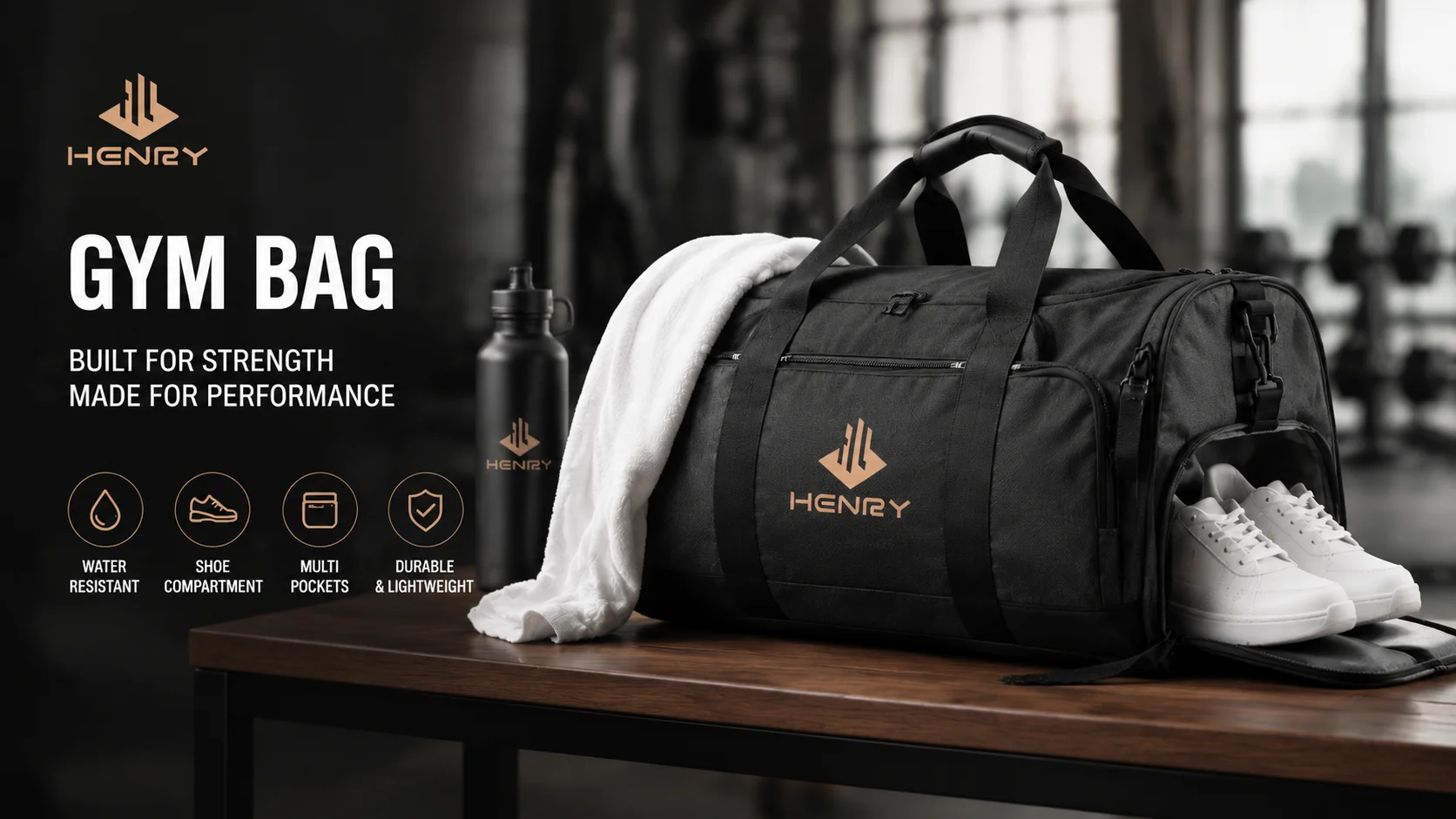
Direct answer: A custom gym bag tech pack is the controlled document that tells a supplier what to quote, sample, manufacture and inspect. At minimum, it should define the intended use, technical drawings, finished dimensions, bill of materials, compartment layout, construction details, branding, labels, packaging, quality criteria and revision history. The RFQ adds quantity, destination, schedule and commercial terms. A reference image alone is not a complete specification.
Custom gym bag tech pack: the 10-point checklist
- Product use, target user and intended packed load.
- Front, back, side, base and interior drawings.
- Finished dimensions, measurement points and tolerances.
- Bill of materials for shell, lining, foam, webbing, mesh and reinforcement.
- Zippers, sliders, buckles, hooks, pullers and other hardware.
- Pocket, shoe, wet-item, laptop and bottle-compartment requirements.
- Seam, reinforcement and workmanship instructions at load-bearing points.
- Logo artwork, method, finished size, color and measured placement.
- Labels, unit packaging, assortment and carton requirements.
- Sample approval, testing, inspection and revision-control rules.
1. What is the difference between a tech pack, an RFQ and an approved sample?
These documents work together, but they do different jobs.
| Document | Primary purpose | Typical contents |
|---|---|---|
| Tech pack | Defines the product | Drawings, measurements, materials, components, construction, branding, labels, packaging and quality requirements |
| RFQ | Requests a comparable quotation | Tech pack or brief, order quantity, color split, destination, target schedule, Incoterm and requested testing or inspection |
| Approved sample | Provides a physical reference | Confirmed appearance, workmanship, material hand feel, functionality and approved revision |
| Purchase order and signed specification | Authorizes the commercial order | Price, quantity, delivery terms, payment terms, specification version, inspection terms and shipment requirements |
The four records should agree. If the written specification and the approved sample differ, the order file should state which document takes precedence and record the approved exception. Do not rely on scattered chat messages as the final production instruction.
A supplier can help complete missing technical details, but the buyer remains responsible for confirming that the final brief matches the intended product, market and claim.
2. Start with the product use case, not a material name
Before selecting 600D polyester, nylon, canvas or another fabric, define what the bag must do. The use case determines the structure, load path, compartment layout and appropriate test plan. Compare common specification choices in the custom gym bag materials and hardware guide.
Include the following information in the first page of the tech pack:
- Product format: duffel, backpack, drawstring bag, tote or hybrid carry.
- Target user: gym member, athlete, team, traveler, employee or promotional recipient.
- Intended contents: shoes, clothing, towel, bottle, laptop, rackets or wet items.
- Expected packed load and how the load will be distributed.
- Carry modes: hand, shoulder, backpack or trolley attachment.
- Use conditions: daily indoor use, travel, outdoor events, wet environments or occasional promotion.
- Target market and sales channel: retail, e-commerce, fitness club, event program or corporate gift.
- Estimated order quantity by color and design.
- Target launch date, destination country and requested delivery term.
Example of a useful product brief
Develop a hybrid gym duffel for daily fitness and short-trip use. It should carry one pair of adult training shoes, a change of clothing, a sports towel, a one-liter bottle and small accessories. Required carry modes are top handle, detachable shoulder strap and stowable backpack straps. The shoe area must be physically separated from the main compartment. Final dimensions, packed-load target and all performance claims will be confirmed during sampling.
This example is useful because it describes the job of the product without pretending that the final engineering decisions have already been made.
3. Create drawings and a point-of-measure table
A bag should be shown from enough angles for a pattern maker, sample team and inspector to understand the same product.
Recommended views include:
- Front, back, left side, right side, top and base.
- Main compartment fully open.
- Each external and internal pocket open.
- Shoe or wet-item compartment shown in relation to the main volume.
- Shoulder strap, handle wrap and backpack-strap storage.
- Cross-sections where foam, board, piping or layered construction is not visible from the outside.
Number every callout. Use the same callout number in the drawing, measurement table and bill of materials.
Define finished measurements
State whether measurements apply to the finished bag when empty, closed and placed in a defined position. Capacity in liters can support comparison, but it does not replace finished external dimensions or a loading check.
| Point of measure | What to define |
|---|---|
| Overall height | Finished measurement points and tolerance |
| Overall width | Whether measured at the widest point, base or opening |
| Overall depth | Empty-bag measuring position and tolerance |
| Main zipper opening | Usable opening length, not only zipper-chain purchase length |
| Handle drop | From the top edge or attachment seam to the handle center |
| Shoulder-strap range | Minimum and maximum usable finished length |
| Backpack-strap range | Minimum and maximum adjustment plus storage method |
| Shoe compartment | Internal usable dimensions and intended footwear size reference |
| Bottle pocket | Opening width, usable depth and retention requirement |
| Laptop sleeve | Maximum device dimensions, foam thickness and closure method |
| Logo placement | Finished logo size and distance from fixed seams or edges |
Avoid a single blanket tolerance for every dimension. A small logo position may need a tighter tolerance than overall bag depth, while soft or padded constructions may require a measurement method that accounts for compression.
4. Build a bill of materials that a supplier can quote
Terms such as “premium Oxford,” “heavy-duty zipper” and “high-quality lining” are not measurable. The bill of materials should identify each component clearly enough for the supplier to propose an equivalent, disclose a substitution or price the requested construction.
| Component | Information to record |
|---|---|
| Outer shell | Fiber, denier or fabric weight, weave, coating or laminate, finish, color reference and required performance |
| Lining | Fiber, construction, weight or density, coating, color and compartment assignment |
| Reinforcement | Foam type and thickness, PE board, reinforcement fabric, binding and patch locations |
| Mesh | Fiber, hole structure, stretch direction, weight and color |
| Webbing | Fiber, width, thickness, weave, color and finished use |
| Zipper chain | Size, coil or tooth construction, tape color, opening type and water-resistant treatment if applicable |
| Sliders and pullers | Quantity, locking or non-locking function, finish, shape and branding |
| Buckles and hooks | Material, dimensions, color, finish and functional requirement |
| Thread and binding | Fiber, size or performance requirement, color and visible finish |
| Labels | Woven label, printed label, care label, origin marking and placement |
| Unit packaging | Polybag, paper sleeve, insert, hangtag, barcode and pack-out method |
Denier, GSM and thickness are not interchangeable
Denier describes yarn linear density. GSM describes mass per unit area. Thickness describes a physical dimension under a stated measurement condition. One number cannot replace the others, and none of them alone proves that a fabric is suitable for a finished gym bag.
“Water resistant” is not the same as “waterproof”
A coated shell fabric may resist light moisture while water still enters through zipper tracks, seams, needle holes or openings. When weather protection matters, define the complete construction, exposure condition, test method and pass/fail criterion. Avoid an unqualified waterproof claim unless the finished product has been tested for the intended use.
5. Specify compartments by the items they must hold
A compartment list should describe usable function, not only appearance.
Shoe compartment
Record the intended footwear dimensions, opening size, lining, ventilation, cleanability and effect on the main compartment. A shoe tunnel that looks large in an empty sample may consume too much clothing space when loaded.
Wet-item pocket
State whether the pocket is intended for temporarily separating damp clothing or is expected to contain free liquid. These are different requirements. Define lining, seam construction, zipper, drainage or ventilation and the exact claim the buyer intends to make.
Laptop or device sleeve
Provide maximum device dimensions, foam type and thickness, closure, bottom clearance and whether the sleeve must protect against the contents of adjacent compartments.
Bottle pocket
Specify bottle diameter and height, opening width, stretch or retention method, drainage and whether the bottle must remain secure while the bag is carried in each intended mode.
Accessory pockets
Identify the contents, opening direction, minimum usable dimensions and any organizer features. A flat drawing should show whether a pocket is applied to a panel or consumes internal volume.
6. Mark the construction details that carry the load
Bag failures often begin where the load changes direction: handle attachments, shoulder-strap anchors, backpack-strap roots, zipper ends, pocket corners and base seams.
The tech pack should identify:
- Seam type and seam allowance where relevant.
- Bound, turned or otherwise finished internal seams.
- Stitch type, thread requirement and visible thread color.
- Reinforcement pattern at handles, straps and high-stress corners.
- Bar-tacks, box stitches, backing patches or additional layers.
- Webbing insertion length and whether webbing continues under a panel.
- Foam, board and base-support placement.
- Requirements for trimmed threads, raw-edge control and internal appearance.
Do not choose an arbitrary stitch count or load value because it appears in another product specification. The construction, fabric, thread, seam geometry and intended load must be evaluated together.
Possible physical and laboratory checks
The buyer, supplier and laboratory should select methods that match the material and product risk. Examples include:
| Property | Why it may matter | Possible approach |
|---|---|---|
| Fabric maximum force | Screens the strength of a proposed woven fabric | ISO 13934-1:2013 may be considered where applicable |
| Seam maximum force | Evaluates a defined sewn seam under laboratory conditions | ISO 13935-2:2026 may be considered for applicable straight seams |
| Fabric abrasion | Supports comparison of exposed textile surfaces | ISO 12947-2:2016 may be considered for applicable fabrics |
| Finished-bag load performance | Checks the complete bag, straps and attachments | Order-specific loading, duration, handling and pass/fail protocol |
| Zipper operation | Checks opening, closing and corner performance | Agreed cycle count, load state and failure definition |
| Strap and hardware function | Checks adjustment, slippage, deformation and attachment | Order-specific functional protocol linked to the intended load |
A standard name alone is not a test plan. Record the specimen, conditioning, method version, parameters, number of samples and acceptance criterion.
7. Match branding to the actual material and construction
Provide production artwork rather than a screenshot. Vector files are usually preferable for line art, embroidery, screen printing, patches and hardware development.
The branding section should state:
- Artwork filename and revision.
- Color reference, including Pantone or another agreed system where appropriate.
- Finished logo width and height in millimeters.
- Placement measured from fixed finished seams or edges.
- Orientation when the bag is carried in each intended mode.
- Approved method and substrate.
- Surface finish, backing, border and reverse-side appearance.
- Required strike-off or physical approval route.
| Branding method | Suitable use | Approval points |
|---|---|---|
| Screen print | Simple spot-color graphics on compatible panels | Ink system, color count, cure, adhesion, edge and fabric compatibility |
| Embroidery | Dimensional wordmarks and emblems | Stitch count, backing, puckering, reverse finish, thread color and panel distortion |
| Heat transfer | Detailed or multicolor artwork | Film finish, edge, adhesion, heat sensitivity and coating compatibility |
| Woven or rubber patch | Repeatable branded component | Mold or setup, dimensions, color, attachment and component minimums |
| Woven label | Small, consistent brand identification | Fold, seam, readability, placement and reverse appearance |
| Custom puller or hardware | High-visibility private-label detail | Material, mold, finish, logo depth, attachment and minimum component quantity |
Approve branding on the actual production material whenever texture, coating, heat or stretch can change the result.
8. Put labels and packaging in the specification before sampling ends
Packaging affects unit cost, carton size, labor, product presentation and inspection. Add it before the supplier confirms the final quotation.
Define:
- Brand label, care label and country-of-origin marking.
- Product identifier, style, color and size information.
- Hangtag, barcode type, barcode data and placement.
- Polybag or paper packaging dimensions and closure.
- Inserts, tissue, straps secured for packing and hardware protection.
- Quantity per inner pack and export carton.
- Color and design assortment by carton.
- Carton marks, carton dimensions and maximum gross-weight requirement.
- Destination-language and warning requirements where applicable.
The responsible brand or importer should confirm labeling and product-safety requirements for the destination market and sales channel. A supplier’s generic label template is not a substitute for an order-specific compliance review.
9. Use sampling as a controlled approval process
A physical sample should answer whether the written specification works. It should not become an undocumented replacement for the specification.
Depending on complexity, the approval route may include:
- Material swatches, color approvals or logo strike-offs.
- Initial development sample for shape and function.
- Revised sample with a consolidated correction list.
- Pre-production sample made from confirmed materials and components.
- Packing sample or final pack-out approval.
Give every sample a style number, revision and date. Keep one consolidated change log.
| Revision | Date | Change | Requested by | Approval status |
|---|---|---|---|---|
| V1 | YYYY-MM-DD | Initial sample | Buyer | Review required |
| V2 | YYYY-MM-DD | Increased shoe opening; moved logo 10 mm | Buyer | Approved with notes |
| PP | YYYY-MM-DD | Confirmed production materials and packaging | Buyer | Approved for production |
When a component changes after approval, record the change and decide whether the risk requires another sample, strike-off or targeted test.
10. Convert the specification into an inspection plan
Identify the characteristics that are critical to quality for the specific bag. Typical checks include:
- Product identity, color and assortment.
- Finished dimensions and logo placement.
- Shell, lining, webbing, zippers, hardware and reinforcement.
- Pocket layout and usable compartment function.
- Open seams, skipped stitches, seam damage and loose components.
- Zipper operation, slider direction and end treatment.
- Strap adjustment, slippage and attachment.
- Print, embroidery, patches and labels.
- Odor, contamination, sharp edges and foreign material.
- Unit packaging, barcode, carton quantity and marks.
Defect classification must be agreed before inspection
A foreseeable safety issue, prohibited material or dangerous sharp component may be classified as critical. A non-functioning zipper, detached strap, wrong material, incorrect logo, open load-bearing seam or dimension outside an agreed functional tolerance may be major. A small cosmetic issue that does not affect function or saleability may be minor.
These are examples only. The final defect list and classification must match the product, market and buyer requirements.
Use AQL sampling correctly
ISO 2859-1:2026 defines acceptance sampling plans for inspection by attributes. The selected lot, inspection level, sampling plan and acceptance quality limits should be stated in the purchase and inspection terms. AQL sampling does not guarantee that every unit is defect-free, and it does not replace product-safety evaluation or laboratory testing.
Do not copy a sample-size table from an unrelated order. Use the applicable standard or a qualified inspection provider to calculate the plan for the actual lot and agreed settings.
11. Copy-and-paste custom gym bag RFQ template
Use the following template in an email, spreadsheet or sourcing form. Replace every bracketed item.
CUSTOM GYM BAG RFQ

1. BUYER AND PROJECT
Company:
Contact:
Project or style name:
Target market(s):
Sales channel:
Intended user and use case:
Target launch or delivery date:

2. COMMERCIAL QUANTITY
Initial order quantity:
Quantity by color/design:
Estimated repeat quantity, if known:
Ship-to city/country:
Requested Incoterm:
Quote freight separately? Yes / No

3. PRODUCT FORMAT
Bag type:
Carry modes:
Intended packed items:
Target packed load:
Reference images or existing sample available:

4. FINISHED DIMENSIONS
Overall height:
Overall width:
Overall depth:
Target capacity, if relevant:
Measurement method:
Dimension tolerances:

5. COMPARTMENTS
Main compartment:
Shoe compartment:
Wet-item pocket:
Laptop/device sleeve:
Bottle pocket:
Other pockets or organizers:

6. MATERIALS
Outer shell:
Lining:
Foam/padding:
Base support:
Mesh:
Webbing:
Binding:
Thread:
Required color references:
Recycled-content request and required evidence, if applicable:

7. ZIPPERS AND HARDWARE
Zipper size/type:
Slider and puller:
Buckles/hooks:
Snaps/feet/other hardware:
Hardware color and finish:
Custom molds required:

8. BRANDING
Artwork filename/revision:
Logo method:
Finished logo size:
Measured placement:
Logo colors:
Other labels or branded components:

9. LABELS AND PACKAGING
Brand label:
Care/origin label:
Hangtag:
Barcode:
Unit packaging:
Units per carton:
Carton marks:
Destination-language or warning requirements:

10. SAMPLE AND APPROVAL
Requested sample route:
Required material or logo approvals:
Approved-sample retention:
Target sample review date:

11. TESTING AND INSPECTION
Critical-to-quality points:
Required laboratory tests:
Required test methods and pass/fail criteria:
Inspection stage:
Sampling plan/AQL settings:
Required inspection report and shipment-release evidence:

12. QUOTATION BREAKDOWN
Unit price:
Sample charge:
Mold/setup charges:
Packaging charge:
Testing charge:
Inspection charge:
Estimated production lead time after approval:
Quotation validity:
Assumptions and exclusions:
12. How to compare quotations fairly
A low unit price may reflect a different material, zipper, reinforcement, logo process, packaging scope or delivery term. Normalize the following items before choosing a supplier:
| Quote line | Comparison question |
|---|---|
| Shell and lining | Are fiber, construction, denier or weight, coating and colors equivalent? |
| Foam and reinforcement | Are thickness, location and base support included? |
| Zippers and hardware | Are size, material, finish, quantity and custom components equivalent? |
| Branding | Are artwork size, method, colors, setup and approval samples included? |
| Packaging | Are labels, barcode, unit pack, carton assortment and carton marks included? |
| Sample route | Does the quotation include revisions, freight and pre-production approval? |
| Testing and inspection | Are the same methods, criteria and third-party costs included? |
| Trade term | Are quotations based on the same Incoterm and destination? |
| Lead time | Does timing begin after deposit, material approval or final sample approval? |
| MOQ | Is the minimum driven by the complete style, each color, fabric dyeing or custom component? |
Ask every supplier to list assumptions and proposed substitutions. A quotation is easier to audit when every important component is named rather than hidden inside one unit price.
Common tech pack mistakes that create delays or price disputes
- Sending only reference photos without measurable dimensions.
- Using capacity in liters as the only size requirement.
- Requesting “premium” material without construction or performance details.
- Forgetting the lining, foam, board, binding, thread and internal finish.
- Adding a shoe or wet compartment without defining the item it must hold.
- Approving a logo on a digital mockup but not on the actual production material.
- Leaving labels, barcode and packaging until production is nearly complete.
- Naming a test standard without method parameters or pass/fail criteria.
- Changing components through chat messages without updating the revision log.
- Treating a general factory or material certificate as proof for every order.
Custom gym bag tech pack FAQ
Do I need professional CAD drawings before contacting a manufacturer?
No. Clear sketches, reference photos and a measurement table can be enough for an initial review. The supplier may help convert the brief into production drawings, but the buyer should approve the final dimensions, callouts and revision before sampling or bulk production.
Can a supplier quote from reference photos only?
A supplier may provide an indicative estimate, but the final price can change when dimensions, materials, lining, reinforcement, zippers, compartments, branding and packaging are confirmed. Ask the quotation to state its assumptions.
What information changes the gym bag price most?
Price is commonly affected by fabric and coating, lining, foam and reinforcement, number and type of compartments, zipper and hardware specification, branding method, custom molds, quantity by color, packaging, testing, inspection and delivery term. The effect is project-specific.
How many samples are normally required?
There is no fixed number. A simple adaptation of an existing construction may need fewer rounds than a new multi-carry bag with custom hardware and complex compartments. Use as many controlled approvals as necessary to resolve material, function, branding and packaging risk.
Should MOQ be written in the tech pack?
Put the requested quantity and color split in the RFQ. The final MOQ depends on fabric, dyeing or printing, custom hardware, labels, packaging and production setup. Ask the supplier to explain which component creates the minimum.
Can the manufacturer help complete the tech pack?
Yes. A capable product-development team can identify missing measurements, propose materials and components, prepare drawings and organize sample revisions. The final version should still be approved by the buyer and linked to the purchase order.
Primary references for test and inspection planning
- ISO 2859-1:2026, Sampling procedures for inspection by attributes — Part 1: Sampling schemes indexed by acceptance quality limit (AQL) for lot-by-lot inspection: https://www.iso.org/standard/85464.html
- ISO 13935-2:2026, Textiles — Seam tensile properties of fabrics and made-up textile articles — Part 2: Determination of maximum force to seam rupture using the grab method: https://www.iso.org/standard/88344.html
- ISO 13934-1:2013, Textiles — Tensile properties of fabrics — Part 1: Determination of maximum force and elongation at maximum force using the strip method: https://www.iso.org/standard/60676.html
- ISO 12947-2:2016, Textiles — Determination of the abrasion resistance of fabrics by the Martindale method — Part 2: Determination of specimen breakdown: https://www.iso.org/standard/61058.html
Scope note: These standards are examples for selecting an order-specific test or sampling plan. They are not automatic requirements for every bag. Confirm the current method, applicability, specimen, parameters and acceptance criteria with the responsible buyer, laboratory or inspection provider.