A useful wet-gear sports duffel brief does more than name a capacity and request a logo. It explains what the bag must carry, how damp and dry items should be organized, where ventilation is intended, how the user will carry the load, and what the buyer will inspect on the sample.
For a clear first sample, make seven decisions before requesting a quotation: the use case, reference size, compartment plan, material direction, ventilation placement, carry system, and branding and packout. Treat every unconfirmed construction or performance detail as a development question, not a finished-product promise.
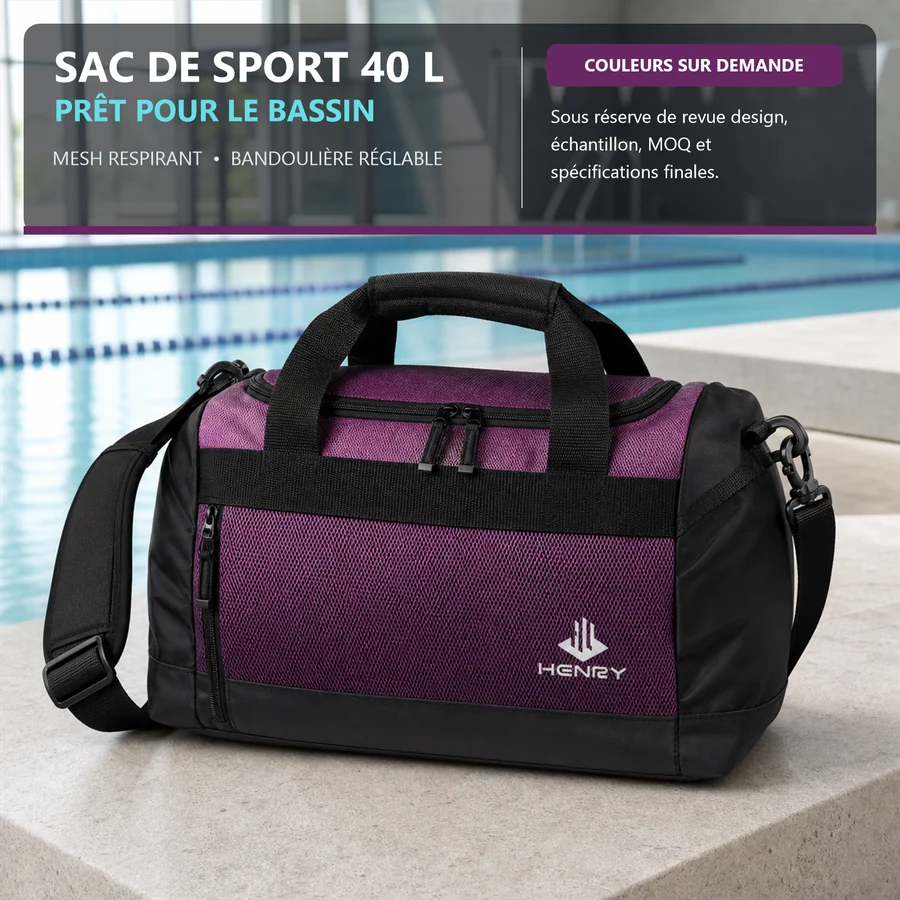
HENRY's launched Custom 40L Wet-Gear Sports Duffel Bag provides a practical reference format. Its verified catalog record combines a 40 L direction, breathable mesh inserts, paired top handles and an adjustable shoulder strap. Those fields are a starting point for a custom project; fabric denier, coating, lining, zipper specification, finished weight, load rating, MOQ, lead time and test results still require project confirmation.
1. Define the actual use case
Start with the user's routine rather than the bag's appearance. A swim-program bag, a gym bag, a team travel bag and a promotional event bag may share a duffel shape, but they can need different organization and handling.
Include these points in the brief:
- who will use the bag;
- what equipment and clothing it should hold;
- whether damp and dry items are carried together;
- whether the bag is used for daily training, short travel, team issue or retail;
- how it is normally stored between uses;
- which items need quick access.
This context helps the supplier evaluate the layout instead of guessing from a capacity label. If the program has several user groups, choose one primary use case for the first sample and record the others as later variants.
2. Set a reference size and packing list
A capacity number is useful, but it should be paired with a simple packing list. The launched HENRY product uses a 40 L reference direction. That does not automatically define the final dimensions or prove that every buyer's equipment will fit.
List the representative contents for the sample review. For example, a buyer might ask the sample team to assess space for training apparel, footwear, a towel and small accessories. Avoid turning the example into a universal capacity claim. The final dimensions and usable internal volume depend on the pattern, panels, pockets, lining and closure construction.
Ask the supplier to confirm:
- proposed external dimensions;
- how the stated capacity is calculated;
- whether pockets are included in that calculation;
- the measurement tolerance to be used for sampling and production;
- the packed shape expected from the agreed contents.
The approval decision should be based on the physical sample and agreed measurement method, not on the capacity label alone.
3. Map compartments before choosing details
Draw a basic compartment map. Identify the main cavity, any wet-gear zone, footwear or accessory areas, bottle or document pockets, and quick-access storage. Mark the intended contents of each area.
This step exposes conflicts early. A large internal pocket can reduce the usable main compartment. A separate section may change the base shape. Extra access points add seams, zippers and reinforcement requirements. None of those choices is automatically good or bad; they simply need to match the program.
For each compartment, specify:
- intended contents;
- opening direction and access position;
- closure type to be evaluated;
- whether the panel is solid, mesh or lined;
- whether it needs reinforcement;
- how it should be inspected when empty and packed.
If separation of damp items is important, describe the intended separation construction. Do not assume that the words “wet-gear” prove sealing or water containment. Lining, seam construction and closure details must be confirmed in the sample specification.
4. Separate material direction from material proof
The verified source direction behind the launched HENRY reference uses nylon and polyester with mesh inserts. A custom brief can ask HENRY to evaluate a nylon/polyester specification, fabric weight, finish and color, but the final component-level composition remains subject to confirmation.
Build a material schedule by component:
- outer body;
- base panel;
- pocket panels;
- mesh zones;
- lining, if required;
- handles and shoulder strap;
- binding and reinforcement;
- zipper tape and other trims.
For each component, record the proposed material, color, hand feel and finish. If coating, repellency, abrasion behavior, tear resistance or colorfastness matters, turn it into a defined sample or production test requirement. Do not publish or approve an unverified performance claim because a material name sounds suitable.
5. Place ventilation intentionally
The launched 40 L reference includes breathable mesh inserts. For a custom project, the buyer should state where ventilation is intended and what items sit next to those panels.
Review mesh placement against three practical questions:
- Does the opening or panel align with the intended compartment?
- Is the mesh protected from high-contact areas and sharp contents?
- Does the surrounding construction support the expected bag shape?
Ventilation is a construction direction, not a guarantee that contents will dry within a particular time. If a program needs a measurable outcome, the buyer and supplier must agree on a test method and acceptance criterion before making that claim.
6. Design the carry system around the load
The verified reference combines paired top handles with an adjustable shoulder strap. Use that arrangement as a starting point, then define how the bag should be carried when loaded.
The sample brief should cover handle position, strap adjustment range, attachment points, padding direction, reinforcement and removable or fixed hardware. Ask the sample review team to check whether the bag remains balanced with the agreed contents and whether closures and pockets remain accessible in each carry mode.
Load and stitching strength are not confirmed by appearance. If they are critical, include an agreed test method, sample load, cycle or duration, and pass/fail rule in the project specification. Until that evidence exists, keep the public description qualitative.
7. Freeze branding, color and packout rules
Branding should be mapped to a defined panel rather than added at the end. Provide artwork format, target dimensions, placement, color reference and the decoration method to be evaluated. HENRY can review logo application, labels and private-label packaging as part of the project brief, but feasibility depends on the selected fabric, construction and artwork.
Only colors already verified in an approved product record should be presented as existing options. Other colors are custom-development requests subject to artwork review, material availability, sampling, MOQ and final specification.
Finish the brief with the packout: folding method, protective bag, labels, inserts, carton marking and quantity per carton. Keep pricing, MOQ and lead time out of assumptions; request current project confirmation instead.
A sample-review checklist buyers can reuse
Use the same controlled checklist for every sample round:
- Match the sample to the approved drawing, dimensions and compartment map.
- Pack the agreed reference contents and review access, shape and balance.
- Confirm every material and trim against the component schedule.
- Inspect mesh placement, surrounding seams and intended ventilation zones.
- Review handle, strap, attachment and reinforcement construction.
- Check logo size, position, color and edge quality against approved artwork.
- Confirm labels, packaging and carton instructions.
- Record deviations with photos and one clear disposition: accept, revise or retest.
When a change affects several parts of the bag, issue a revised specification rather than relying on comments scattered across messages. That keeps the next sample and eventual production review tied to one current source of truth.
A copy-ready RFQ block
Send the following fields with the inquiry:
Program and user: primary activity, user group, sales or distribution channel, and expected use pattern.
Reference format: target capacity direction, proposed dimensions and representative packing list.
Organization: compartment map, intended contents, openings, closures, lining and mesh requirements.
Materials: component-by-component material, finish, color and trim direction.
Carry: handle and shoulder-strap configuration, attachment points, padding and hardware.
Branding: artwork, method to evaluate, size, position, colors and labels.
Packout: individual packaging, inserts, carton marking and quantity requirements.
Verification: measurements, workmanship checks and any agreed project-specific tests.
Commercial confirmation: target quantity, destination and requested timing for current MOQ, lead-time and shipping review.
Frequently asked questions
Is 40 L the required size for a wet-gear sports duffel?
No. It is the verified reference direction for the launched HENRY model discussed here. Final capacity and dimensions should follow the buyer's packing list, pattern and compartment plan.
Do mesh inserts make a bag waterproof or guarantee drying?
No. Mesh inserts describe an airflow-focused construction direction. Water containment, drying behavior and other performance outcomes require a defined construction and an agreed test method.
Can buyers request custom colors and branding?
Yes, as conditional development. Color, decoration, labels and packaging remain subject to artwork review, material availability, sampling, MOQ and final specification.
What should be approved before production?
Approve the current specification, physical sample, materials and trims, dimensions and tolerances, compartment layout, branding, packout and any agreed test criteria. Commercial terms should also be reconfirmed for the specific project.
Turn the checklist into a sample brief
The fastest next step is to send HENRY one packing list, one compartment sketch and one branding file. Use the Custom 40L Wet-Gear Sports Duffel Bag as a reference, compare related options in Custom Bags, and submit the project through the custom inquiry form. HENRY will review the feasible construction, unresolved details and the confirmations required before sampling.
Source and product reference
- HENRY GOOD, Custom 40L Wet-Gear Sports Duffel Bag, verified reference configuration and conditional customization scope, accessed August 3, 2026.