Direct answer: Before describing a cooling towel as “cooling,” “quick dry” or “highly absorbent,” define what those words mean for your intended customer and compare the actual sample under recorded conditions. Use the same wetting, wringing, environment, timing and wash history for every comparison. Keep the measured result separate from a user's reported cooling sensation.
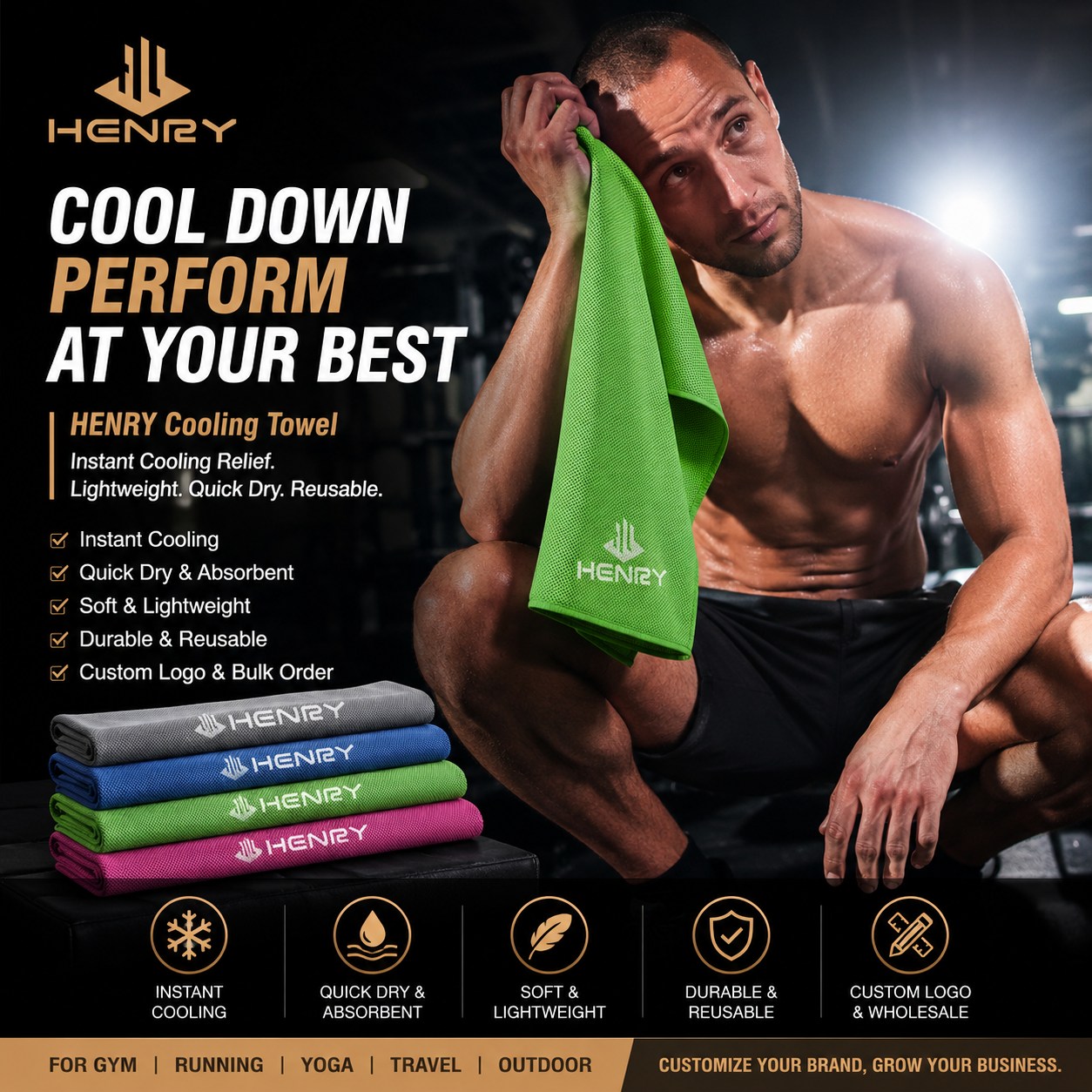
The green reusable cooling sports towel and grey custom-logo cooling gym towel are HENRY product references for programs that involve wetting and wringing the fabric before use. They show possible branding directions; neither page supplies a quantified temperature reduction, drying-time benchmark or independent test result. The plan below is a proposed way to evaluate a future sample, not a report of tests already completed.
Decide what each claim means
A buyer may mean subjective comfort, lower measured surface temperature, sweat pick-up or time to dry. Those are different questions. Choose the claim you actually plan to print and the comparison that would support it before deciding whether the sample passed.
| Possible claim | Proposed evidence to collect | Important limit |
|---|---|---|
| Refreshing cooling feel | Use a documented wet-and-wring procedure; ask a small, consistently instructed user group to record comfort at defined times. | Reported sensation is not a measured body-temperature or health outcome. |
| Measured temperature change | Choose a temperature instrument, measurement point, reference towel, exposure period and repeat plan before testing. | Do not turn one reading into an “instant” or universal temperature claim. |
| Absorbs perspiration | Compare a known fluid amount, contact time and mass change on conditioned samples. | A lab-style water check may not reproduce every workout. |
| Quick drying | Wet the samples consistently, record starting mass and ambient conditions, then weigh or observe at agreed intervals. | Drying depends on temperature, humidity, airflow and towel size. |
| Reusable after washing | Repeat selected checks after the agreed care cycles; inspect dimensions, appearance, logo and edges. | “Reusable” does not establish a specific service life without a defined test. |
Control the comparison before anyone sees the results
Identify each sample by material, construction, dimensions, colour, logo process and production version. Select a relevant reference towel if the planned claim is comparative. Equalize the conditions of both samples and state the acceptance criteria in the test brief before testing.
- Wet activation: record water temperature and amount, immersion or wetting time, and how excess water is wrung out.
- Environment: record room or outdoor temperature, humidity, airflow and whether direct sunlight is present.
- Timing: define the start point and every observation interval; use the same schedule for each sample.
- Handling: use the same contact surface or body location, with a consistent procedure where user evaluation is involved.
- Wash history: distinguish a new sample from one washed using the agreed care method.
If any condition changes, mark the result as a different run rather than averaging unlike observations. A moist towel may feel cooler partly because water evaporates; the degree and duration in a particular setting need evidence before they become a numerical marketing claim.
Run a sample-review sequence
- Inspect dry samples. Record fabric identity, finished size, mass, edge finish, label, logo and any visible defects.
- Activate consistently. Wet and wring each towel to the agreed procedure. Record the remaining wet mass so one sample is not simply carrying much more water.
- Review intended use. Check feel around the neck or on the skin at the agreed intervals. If measuring surface temperature, use the selected instrument and measurement points consistently.
- Check absorbency and drying separately. Use the pre-agreed liquid-contact and drying procedures rather than treating a cooling-feel result as proof of either claim.
- Repeat after care. Wash using the proposed label instructions and rerun the checks chosen as important. Inspect logo, dimensions, hand feel and seams.
- Review the packed product. Check any pouch, label and instruction card against the final wording and physical sample.
For a claim requiring formal verification or a specified test standard, commission the appropriate qualified laboratory and document the method. This buyer-level plan is not a substitute for a certified test report or destination-market review.
Record results without overstating them
Use a sheet with sample IDs, method version, operator, date, conditions, raw observations, photos, deviations and a decision for each proposed claim. A useful approval table looks like this:
| Claim or decision | Result to retain | Possible copy decision |
|---|---|---|
| Cooling feel when dampened | Wetting procedure and timed user observations | Describe the wet-use experience only if observations support it. |
| Numerical cooling claim | Repeatable temperature data, reference and method | Do not publish a number without suitable substantiation. |
| Quick drying | Conditioned mass or drying observations and comparison | State the context; avoid an absolute promise. |
| Repeated use | After-care appearance and functional checks | Claim only what the tested care history supports. |
| Branding and packaging | Approved physical logo and packed sample | Match the artwork and instructions to the final product. |
“Instant cooling,” medical relief, heat-stress prevention and quantified temperature reduction are stronger claims than a refreshing feel. Do not infer them from a promotional image, subjective anecdote or a single uncontrolled reading. The sports towel inspection checklist can help organize related appearance and construction checks.
Send a test-ready brief with the inquiry
Tell the development team whether the towel is for gyms, events, running clubs or retail; the target size and fabric direction; intended colours, logo and packaging; expected quantity; and the exact claims you want to substantiate. Add your preferred reference towel, use environment and wash-care plan. Unknowns can remain questions for sampling.
Compare the green reusable option and grey custom-logo option, browse cooling towel platforms, or send your cooling towel brief.
Frequently asked questions
Does a wet towel feeling cooler prove a specific temperature drop?
No. User-reported comfort and measured temperature are different observations. A numerical claim needs a defined instrument, reference and repeatable method.
Can one sample support every colour or fabric version?
Not automatically. A change in material, construction, size, finish or logo process may affect the result. Record which versions were actually reviewed.
Does this guide report a completed HENRY performance test?
No. It is a proposed buyer test plan. Any performance result should be evaluated and documented for the actual sample and final specification.
Product and method references
- HENRY GOOD, Reusable Cooling Sports Towel, wet-and-wring use and custom-program reference, accessed October 21, 2026.
- HENRY GOOD, Custom Logo Cooling Gym Towel, second design and branding reference, accessed October 21, 2026.
- HENRY GOOD, Custom Sports Towel Inspection Checklist, related inspection-planning guide, accessed October 21, 2026.
The comparison methods on this page are proposed checks for future samples. No measured product result is presented as completed.