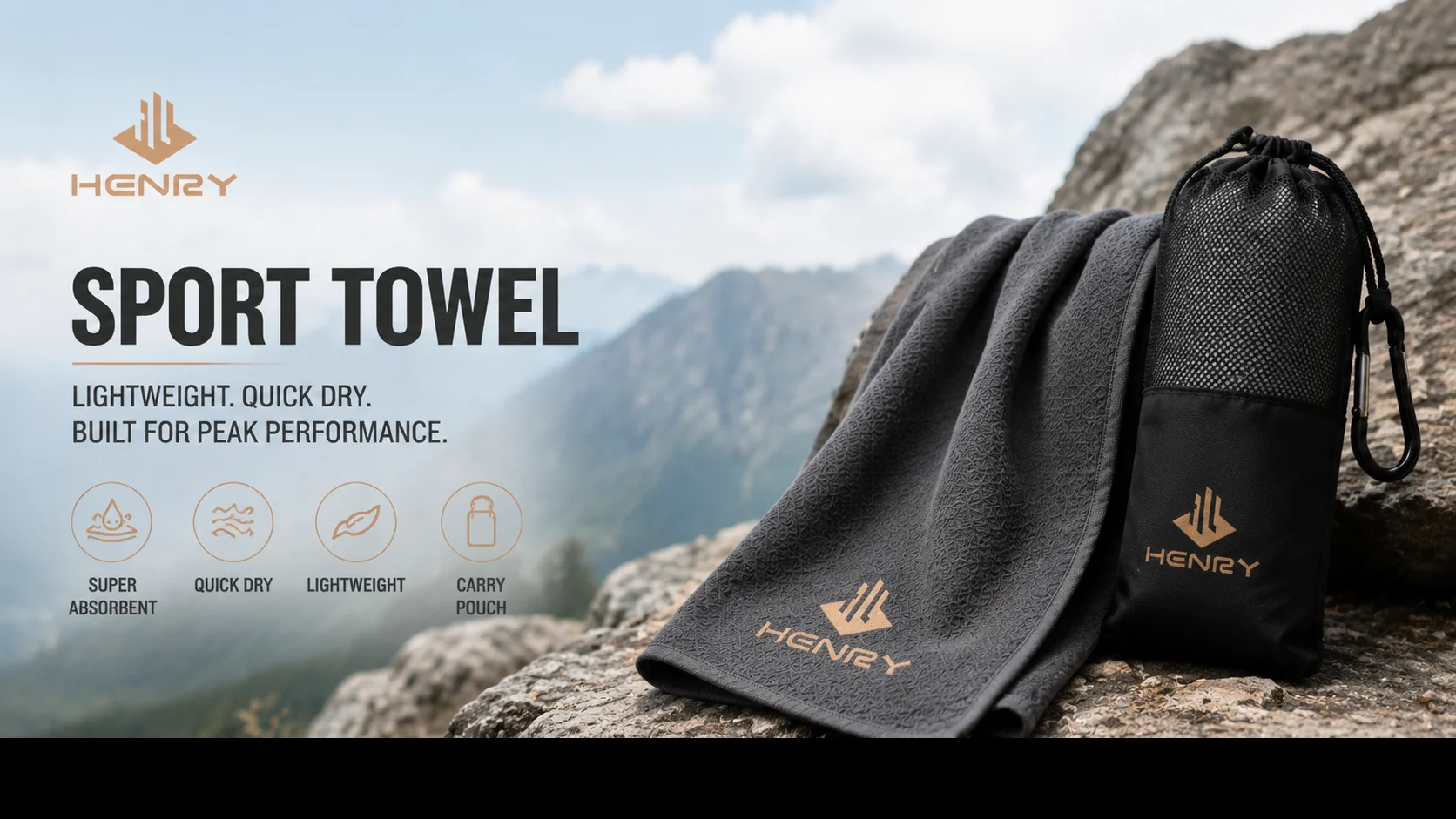
Direct answer: Release a custom sports towel shipment against a signed specification and approved sample, not against appearance alone. Before inspection, define the lot, sampling plan, defect classes, measurement method, tolerances, artwork, labels and packaging. Inspect product identity, quantity, material, finished dimensions, GSM or piece weight, color, surface, edges, logo, attachments, cleanliness and pack-out. Use laboratory tests separately for claims such as fiber composition, absorbency, dimensional change and colorfastness. AQL sampling can guide lot acceptance, but it does not prove that every piece is defect-free or replace product-safety and compliance work. Confirm the chosen process and approval points with the custom towel logo and printing methods guide.
Quick shipment-release checklist
- Confirm the inspected lot matches the purchase order and packing list.
- Use the signed specification and approved sample as controlled references.
- State the sampling plan and critical, major and minor defect limits.
- Verify towel type, fiber or material declaration, construction and color.
- Measure finished size using the agreed conditioning and method.
- Check GSM or unit weight using a method appropriate to the construction.
- Inspect print, embroidery, labels, grommets, clips, loops and edge finish.
- Check odor, contamination, stains, loose fibers and foreign material.
- Verify folding, barcode, unit packaging, assortment, carton count and marks.
- Record measured values, defects, photographs, rework and the release decision.
1. Factory QC, pre-shipment inspection and laboratory testing are different controls
A reliable quality plan uses the appropriate control at the appropriate stage.
| Control | Main purpose | Typical timing | What it cannot do alone |
|---|---|---|---|
| Incoming material control | Confirms received fabric, yarn, color, labels and components against approved references | Before cutting, printing or sewing | Does not prove finished-product consistency |
| In-line production control | Finds process problems while correction is still practical | During printing, cutting, edging, embroidery and assembly | Does not represent the final packed lot |
| Pre-shipment inspection | Samples finished goods for workmanship, measurements, identity and packaging | After the order is sufficiently complete and representative | Does not reliably verify every unit or all laboratory properties |
| Laboratory testing | Measures defined physical, colorfastness, chemical or material properties | Development, pre-production or bulk stage as agreed | Does not replace visual and packaging inspection of the shipment |
Do not ask a final inspector to “check everything” without a specification. The inspector needs measurable criteria, approved references and a clear decision rule.
2. Build the towel inspection file before production begins
The inspection file should be linked to the purchase order and contain the final approved versions of:
- Product and style number.
- Towel type, intended use and destination market.
- Fiber declaration, material construction and approved fabric reference.
- Finished dimensions, measurement points and tolerances.
- Target GSM or unit weight and the agreed verification method.
- Color reference and approved shade or print strike-off.
- Logo artwork, method, finished size and measured placement.
- Edge, hem, corner and seam construction.
- Grommet, carabiner, loop, clip or other attachment specification.
- Care label, origin marking, product identifier and barcode data.
- Folding, unit packaging, assortment and carton instructions.
- Approved sample number and date.
- Defect classification guide with photographs where possible.
- Sampling plan, test methods and pass/fail criteria.
State the document hierarchy
If the approved sample, artwork and written specification conflict, the inspection team should not guess. State which record takes precedence and document any approved deviation.
A practical hierarchy may be:
- Signed order specification and approved revision list.
- Approved production artwork and color reference.
- Approved pre-production sample.
- Purchase order and packing specification.
The exact hierarchy is a commercial decision. The important point is that it is written before inspection.
3. Define the inspection lot and sampling plan
Keep the lot identifiable
The inspection request should identify:
- Purchase order and style number.
- Total order quantity.
- Quantity by material, color, size, logo and packaging version.
- Number of cartons and carton-number range.
- Production location and inspection location.
- Whether reworked goods or replacement units are included.
Do not combine visibly different styles or production groups into one sampling decision without agreement. A mixed lot can hide a problem concentrated in one color, print, size or manufacturing batch.
Use AQL as a sampling system, not a quality slogan
ISO 2859-1:2026 defines acceptance sampling plans for inspection by attributes. The applicable sample size and accept/reject numbers depend on the lot, inspection level, sampling plan and selected AQL settings.
AQL should not be described as a guaranteed percentage of defects in the shipment. It is an index used within an acceptance-sampling system. A passing sample does not prove that every piece is conforming, and a visual AQL inspection does not replace product-safety evaluation or laboratory testing.
Before inspection, agree:
- Lot definition.
- Normal, tightened or reduced inspection status if relevant.
- Inspection level.
- Single, double or other applicable sampling plan.
- Critical, major and minor defect classifications.
- AQL setting for each defect class.
- Rule for repeated defects and multiple defects on one unit.
- Reinspection rule after sorting or rework.
There is no universal AQL setting for all towels. The buyer should select the plan according to product risk, customer requirements, sales channel and past supplier performance. Use the current standard or a qualified inspection provider rather than copying a table from an unrelated order.
4. Custom sports towel pre-shipment inspection checklist
The following table can be adapted to microfiber suede, waffle microfiber, cotton terry, cooling towels, beach towels, gym towels and golf towels.
| Inspection category | What to check | Practical method | Example nonconformity |
|---|---|---|---|
| Product identity | Style, material, color, size, logo and packaging version | Compare unit, labels and carton data with the PO and signed specification | Wrong style, mixed artwork revision or incorrect color name |
| Quantity and assortment | Total cartons, units per carton and color/design split | Count selected cartons and reconcile with packing list | Missing units, incorrect assortment or repeated short pack |
| Fabric construction | Suede, waffle, terry, mesh or other approved structure | Compare with approved swatch and specification; laboratory verification where required | Wrong weave, pile, texture, blend or fabric substitution |
| Fiber declaration | Polyester, polyamide, cotton or blend percentage | Check labels and supporting test documents; use suitable fiber analysis when required | Label claim does not match approved declaration or test record |
| Finished dimensions | Width, length and any special shape | Condition and measure using agreed points, tension and tolerance | Towel too short, skewed, stretched or outside tolerance |
| GSM or unit weight | Approved material weight or finished-piece weight | Use calibrated scale and agreed calculation or specimen method | Systematic underweight, large variation or wrong construction |
| Color and shade | Solid color, print color, shade consistency and color blocking | Compare under controlled lighting with approved reference | Mixed shade, visible panel variation, off-color print or staining |
| Surface and hand | Pile, loops, waffle grid, suede face, mesh holes and finishing | Visual and tactile comparison with approved sample | Pulled loops, bald areas, snagging, hard hand or uneven brushing |
| Edges and corners | Hem width, binding, overlock, corner shape and stitch security | Measure and inspect both sides and all corners | Open hem, skipped stitches, wavy edge or exposed raw edge |
| Print quality | Registration, resolution, bleed, banding, penetration and edge | Compare with approved artwork and strike-off | Blurred logo, color banding, white gap, transfer mark or peeling |
| Embroidery | Size, stitch density, backing, puckering, threads and reverse finish | Measure and compare with approved sample | Puckering, unreadable small text, loose thread or wrong placement |
| Logo placement | Distance from finished edges or fixed seams | Measure using specified reference points | Logo rotated, mirrored or outside placement tolerance |
| Attachments | Grommet, carabiner, loop, clip, snap or pouch | Check dimensions, setting, operation, finish and security | Loose grommet, sharp edge, incorrect hook or weak loop seam |
| Cleanliness and odor | Stains, oil, dust, mold indication, insects, metal or foreign material | Visual and odor check under suitable conditions | Oil spot, strong abnormal odor, foreign object or visible contamination |
| Labels and markings | Brand, care, fiber, origin, identifier and language | Match content, position and legibility with approved file | Wrong fiber claim, missing origin, unreadable label or wrong language |
| Barcode and retail data | Symbology, encoded data, placement and scan performance | Scan sampled codes and compare with master data | Code does not scan, wrong SKU or duplicated label |
| Unit packaging | Fold, insert, polybag or sleeve, closure and warning | Compare with packing specification | Wrong fold, exposed hardware, missing insert or damaged retail pack |
| Export cartons | Carton size, quantity, assortment, marks and condition | Measure, weigh and inspect selected cartons | Wrong carton mark, weak carton, water damage or excess gross weight |
Measuring finished dimensions
Use the same measurement condition for sample approval and bulk inspection. State whether the towel is relaxed, conditioned, lightly smoothed or measured immediately after unpacking. Do not stretch a knit or microfiber construction to force it into tolerance.
For rectangular towels, measure width and length at defined positions. For tri-fold, shaped or hooded constructions, add a diagram showing every point of measure.
Checking GSM and piece weight
GSM means grams per square meter, but there are two different questions:
- What is the mass per unit area of the base fabric?
- What is the effective mass per unit area of the finished towel, including hems, binding, labels or attachments?
A destructive fabric-specimen method is more controlled for base-fabric GSM. A non-destructive finished-product estimate can be calculated as:
Estimated finished-product GSM = net towel mass in grams ÷ finished area in square meters
For example, use the towel mass after removing detachable packaging and hardware only if the written method requires that removal. Record whether labels, edge binding, embroidery, grommets or clips remain in the measured mass. Otherwise, two inspectors can produce different results from the same product.
Do not treat GSM as a complete quality grade. Towels at the same GSM can differ in fiber, yarn, weave or knit, finishing, absorbency, drying, lint, hand feel and durability.
Checking color and shade
Define the approved reference: Pantone target, lab dip, fabric swatch, print strike-off or approved sample. Compare under controlled and consistent lighting. Record whether the acceptable decision is based on instrumental color data, visual assessment or both.
Inspect color within a towel and across sampled units. Shade variation can occur between fabric lots, print runs, panels, borders, binding and embroidery thread.
5. Defect examples and classification
The same physical issue can have a different classification depending on product use and customer requirements. Build an order-specific defect list rather than relying only on generic names.
Possible critical defects
A critical defect is typically associated with an unacceptable safety, legal or prohibited-material risk. Examples that may require critical classification include:
- Sharp grommet, clip or broken component that can injure a user.
- Needle, metal fragment or other dangerous foreign object.
- Evidence of serious contamination.
- Missing safety information where the information is required for the product and market.
- Product or material that violates a specifically agreed legal restriction.
The buyer or qualified compliance adviser should define the final critical list. An inspector cannot confirm every chemical or regulatory requirement through visual examination.
Possible major defects
A major defect can make the product unusable, materially reduce saleability or cause it to differ from the approved specification. Examples may include:
- Wrong towel material, construction, color, size or artwork.
- Dimension outside an agreed functional tolerance.
- Systematic GSM or piece-weight failure.
- Open hem, seam failure or severe edge distortion.
- Print peeling, severe banding, incorrect registration or unreadable logo.
- Embroidery puckering that distorts the towel or makes the logo unacceptable.
- Missing, loose or non-functioning grommet, carabiner or loop.
- Persistent abnormal odor, oil stain or visible contamination.
- Wrong fiber label, barcode, origin marking or retail packaging.
- Repeated shade mismatch within a retail set or shipment.
Possible minor defects
A minor defect generally does not materially affect function or saleability but departs from the agreed workmanship level. Examples may include:
- Isolated loose thread within the agreed cosmetic limit.
- Small removable lint or light packing crease.
- Slight but acceptable corner-shape variation.
- Minor print speck below the approved defect-size threshold.
- Cosmetic variation on hidden packaging surfaces.
Avoid phrases such as “slight defect” without a measurable limit or reference photograph. When appearance matters, a defect guide with scale, location and maximum count is more useful.
6. Select laboratory and performance tests according to the claim
A visual inspection can identify appearance and workmanship problems. It cannot reliably verify fiber percentage, absorbency performance, wash durability, dimensional change, restricted substances or colorfastness.
Possible test areas include:
| Property or claim | Why it matters | Example method or planning reference |
|---|---|---|
| Absorbency | Supports a moisture-absorption claim or product comparison | AATCC TM79-2025 may be considered for absorbency of textiles |
| Drying behavior | Supports a defined quick-dry comparison | Select an applicable AATCC drying method and specify the exact conditioning, moisture load and endpoint |
| Dimensional change | Controls shrinkage, growth and distortion after washing | ISO 3759:2011 for preparation and measurement, ISO 6330:2021 for washing/drying procedures and ISO 5077:2007 for calculation |
| Colorfastness to laundering | Evaluates color change and staining under defined laundering conditions | ISO 105-C06:2010 may be considered where applicable |
| Colorfastness to rubbing | Evaluates dry and wet color transfer | ISO 105-X12:2016 may be considered where applicable |
| Fiber composition | Verifies the declared blend | Select the applicable fiber-analysis method for the declared fibers |
| Print or logo durability | Checks cracking, peeling, fading, puckering or detachment | Agreed wash or use cycle followed by defined visual and physical criteria |
| Attachment security | Checks grommet, loop, clip or hardware retention | Order-specific pull, operation or use simulation with a defined pass/fail value |
| Chemical or product safety | Supports destination-market requirements | Test plan selected by product, material, user group, claim and market |
Absorbency and drying are not the same property
A towel can absorb quickly but retain moisture for longer, or absorb less total water but release it faster under a defined drying condition. Specify whether the intended claim concerns wetting time, liquid uptake, absorbent capacity, wicking, drying time or drying rate.
Do not publish a universal “times faster” statement without identifying the compared products, dimensions, mass, conditioning, moisture load, airflow, temperature, humidity and endpoint.
Wash tests need a complete procedure
“Wash tested” is incomplete. Record:
- Number of cycles.
- Washing-machine type and procedure.
- Detergent and ballast where applicable.
- Water temperature.
- Drying method.
- Measurements or grades before and after washing.
- Pass/fail criteria for dimension, color, print, embroidery, edge and attachments.
7. Special inspection risks by towel construction
| Towel construction | Useful inspection focus | Common risk to control |
|---|---|---|
| Microfiber suede | Surface uniformity, print resolution, edge shape, piece weight and hand feel | Banding, white gaps, heat marks, wavy edges or inconsistent finishing |
| Waffle microfiber | Grid scale, snagging, distortion, absorbency target and binding | Uneven waffle structure, pulled yarns, skew or edge curling |
| Cotton terry | Pile density, loop pulls, lint, border, piece weight and wash change | Bald areas, excessive pulled loops, uneven pile, border shrinkage or lint |
| Cooling mesh towel | Mesh or perforation consistency, stretch, hand feel, print and care instructions | Hole damage, harsh finish, distortion or unsupported cooling claim |
| Printed beach towel | Artwork scale, color registration, bleed, edge, size and packing | Color mismatch, banding, reversed art, white edge or large-panel distortion |
| Golf towel | Grommet, carabiner, loop, folded presentation and logo balance | Sharp hardware, loose setting, corrosion concern, bulky embroidery or wrong orientation |
| Gym towel with pocket | Pocket opening, zipper, seam, usable towel area and laundering | Hard component against skin, pocket distortion, zipper failure or trapped moisture |
Inspect the towel as a complete product. A passing base fabric does not automatically mean the logo, edge, hardware and packaging will perform together.
8. What a useful inspection report should contain
A report should allow a buyer who was not present to understand what was checked and why the lot passed or failed.
Include:
- Supplier, factory or inspection location.
- Purchase order, style and inspected lot.
- Production and packing status at the time of inspection.
- Sampling plan, sample size and selected carton numbers.
- Reference documents and approved sample identification.
- Measured values for dimensions, weight, logo placement and cartons.
- Defect count by class, with unit and defect photographs.
- Barcode scan and label verification results.
- Packaging and assortment checks.
- Test equipment identification and calibration status where relevant.
- Any deviation, rework completed during inspection or unresolved issue.
- Overall result and the decision rule used.
Ask for raw measurement data, not only “PASS.” A dimension table showing every sampled value helps identify drift that may be hidden by an overall result.
The inspector reports evidence. The buyer or authorized quality representative makes the shipment-release decision according to the purchase terms.
9. Copy-and-paste sports towel inspection brief
Use this template when booking an internal or third-party inspection.
CUSTOM SPORTS TOWEL INSPECTION BRIEF

1. ORDER IDENTIFICATION
Buyer:
Supplier:
Factory/location:
Purchase order:
Style number:
Product description:
Destination market:
Inspection date:

2. LOT DEFINITION
Total order quantity:
Quantity by color/size/artwork:
Total cartons:
Carton number range:
Reworked or replacement goods included? Yes / No
Packing list version:

3. CONTROLLED REFERENCES
Signed specification version/date:
Approved sample number/date:
Artwork version/date:
Approved color reference:
Packing specification version/date:
Document precedence rule:

4. SAMPLING PLAN
Applicable standard or buyer procedure:
Inspection level:
Sampling plan:
Critical AQL/acceptance rule:
Major AQL/acceptance rule:
Minor AQL/acceptance rule:
Reinspection rule:

5. PRODUCT SPECIFICATION
Towel construction:
Declared fiber composition:
Finished width and tolerance:
Finished length and tolerance:
Target GSM or unit weight:
GSM/weight verification method:
Color and shade requirement:
Edge/hem/binding construction:
Logo method, size and placement:
Attachment specification:

6. LABELS AND PACKAGING
Brand label:
Care/fiber/origin label:
Product identifier:
Barcode and master data:
Unit fold and packaging:
Units per carton:
Color/design assortment:
Carton dimensions/weight limit:
Carton marks:

7. WORKMANSHIP AND DEFECT GUIDE
Critical defect examples:
Major defect examples:
Minor defect examples:
Maximum isolated cosmetic defect size/count:
Photographic defect references attached? Yes / No

8. ON-SITE CHECKS
Product identity and assortment:
Finished dimensions:
GSM or unit weight:
Color and shade:
Surface/pile/weave:
Edges and corners:
Print/embroidery/logo placement:
Grommet/clip/loop/zipper:
Cleanliness, odor and foreign material:
Labels, barcode and packaging:
Carton count, marks and condition:

9. LABORATORY OR PERFORMANCE RECORDS
Required test report(s):
Method/version:
Tested material or product:
Report holder/legal entity:
Report date and validity:
Pass/fail criteria:
Does report match the actual order scope? Yes / No / Review required

10. REPORTING AND RELEASE
Required raw measurement table:
Required photographs:
Defect count by class:
Immediate rework allowed during inspection? Yes / No
Who authorizes a concession:
Who makes the shipment-release decision:
10. What to do after a failed inspection
A failed inspection should trigger a controlled response, not an informal promise that the problem will be “watched next time.”
- Isolate the affected lot and stop shipment release.
- Identify whether the issue is isolated, systematic or concentrated in one color, carton or production batch.
- Agree sorting, rework, replacement or remake actions in writing.
- Define the reinspection scope and whether a new random sample is required.
- Record the root cause and corrective action for repeat orders.
- Update the specification, defect guide or process control if the original requirement was unclear.
- Accept a concession only through an authorized written approval that states the exact deviation and quantity.
Do not accept “within industry tolerance” unless that tolerance was identified and approved for the order. The purchase specification should define the release criteria.
Custom sports towel inspection FAQ
What AQL should be used for towels?
There is no universal AQL setting for every towel order. Select the sampling plan and defect limits according to product risk, customer requirements, sales channel, order value and supplier history. State the exact settings in the purchase and inspection terms.
Is GSM enough to judge towel quality?
No. GSM controls mass per unit area, but towel performance also depends on fiber, yarn, weave or knit, pile, splitting, finishing, absorbency, drying, lint, colorfastness, edge construction and wash durability.
Can an inspector test absorbency at the factory?
A simple on-site check can screen for an obvious problem, but it should not be presented as a controlled performance result unless the method, conditioning, water volume, timing, equipment and acceptance criterion are defined. Use an appropriate laboratory method for a formal claim.
How should towel shrinkage be checked?
Mark and measure the specimen using an agreed procedure, wash and dry it under a defined cycle, then calculate dimensional change. ISO 3759, ISO 6330 and ISO 5077 provide a possible framework when applicable. State the exact procedure and acceptance limits.
Does an approved sample guarantee bulk quality?
No. The approved sample defines the intended product and workmanship reference. Bulk consistency still requires material control, production checks and an agreed final inspection or release process.
When is third-party inspection useful?
It can be useful for new suppliers, high-value orders, retail launches, strict packaging programs, repeated quality problems or situations where the buyer cannot verify the lot directly. The inspection brief must still define the product and decision rules.
How should printed microfiber towels be inspected?
Check artwork revision, orientation, scale, color, registration, resolution, banding, bleed, edge appearance and transfer marks against the approved strike-off or sample. Add a defined wash or durability test when the print claim requires it.
Primary references for test and inspection planning
- ISO 2859-1:2026, Sampling procedures for inspection by attributes — Part 1: Sampling schemes indexed by acceptance quality limit (AQL) for lot-by-lot inspection: https://www.iso.org/standard/85464.html
- ISO 3759:2011, Textiles — Preparation, marking and measuring of fabric specimens and garments in tests for determination of dimensional change: https://www.iso.org/standard/57309.html
- ISO 6330:2021, Textiles — Domestic washing and drying procedures for textile testing: https://www.iso.org/standard/75934.html
- ISO 5077:2007, Textiles — Determination of dimensional change in washing and drying: https://www.iso.org/standard/41877.html
- ISO 105-C06:2010, Textiles — Tests for colour fastness — Part C06: Colour fastness to domestic and commercial laundering: https://www.iso.org/standard/51276.html
- ISO 105-X12:2016, Textiles — Tests for colour fastness — Part X12: Colour fastness to rubbing: https://www.iso.org/standard/65207.html
- AATCC standards directory, including TM79 Absorbency of Textiles and drying-rate methods: https://www.aatcc.org/testing/standards
- AATCC 101st edition update identifying TM79-2025 and TM135-2025 revisions: https://www.aatcc.org/news-read/insights/announcing-the-101st-edition-of-the-aatcc-manual-of-international-test-methods-and-procedures
Scope note: These are planning references, not automatic requirements for every towel. The buyer, laboratory or qualified adviser should confirm applicability, current method version, test parameters, specimen, destination-market requirements and pass/fail criteria.