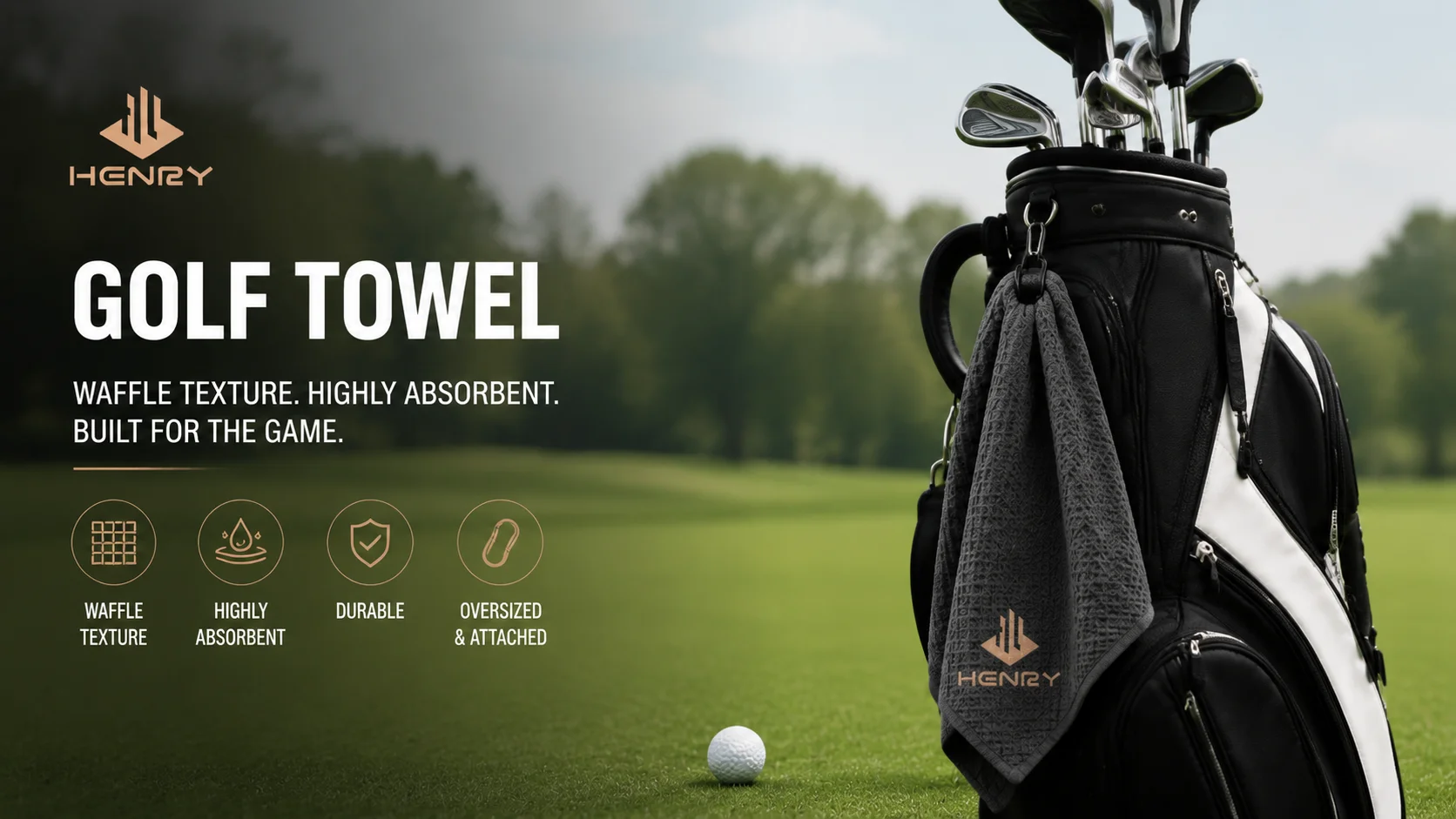
Quick buyer decision
- Choose waffle microfiber for compact cleaning texture and fast drying, or cotton terry for a familiar plush hand feel.
- Specify finished size, GSM or fabric weight, edge construction and dimensional tolerance.
- Approve the logo on the actual towel fabric and record attachment hardware separately.
- Test absorbency, colorfastness, lint, shrinkage and workmanship according to the intended market and claim.
1. Start with the golf program, not the fabric swatch
The right towel for a premium pro-shop line may be different from the right towel for a one-day tournament, subscription box or golf-bag accessory set. Before comparing materials, define the commercial job.
Retail programs usually need tighter packaging, labeling and repeat-color control. Event programs may prioritize delivery date and artwork visibility.
State whether the towel is mainly for clubs, balls, hands or general course use. Soil type and wet-use expectations affect fabric choice.
Define whether the product should feel lightweight and technical, plush and traditional, or gift-ready.
Identify countries, online marketplaces, club shops, distributors or corporate-gift channels before labeling and packaging are finalized.
Reference images are useful for direction, but they do not replace dimensions, material, weight, color, logo, edge, attachment and packing specifications. Put those details into a single version-controlled brief.
2. Choose the finished size and course format
Golf towels are commonly offered as rectangular, tri-fold or compact square formats. There is no single correct size. The product needs enough working area without hanging too low, dragging or crowding the golf bag.
| Format | Typical advantage | Specification detail | Watch point |
|---|---|---|---|
| Rectangular towel | Large usable surface and visible logo zone | Finished width and length, corner radius, grommet position | Long towels can hang low when attached to the bag |
| Tri-fold towel | Compact presentation with separate folds | Folded and open dimensions, top header, center grommet | Embroidery and hardware can make the folded top bulky |
| Square towel | Balanced promotional or accessory format | Finished size, loop or corner attachment, logo orientation | Small formats need careful logo-to-use-area balance |
| Dual-texture towel | Different cleaning surfaces in one product | Panel materials, seam, color matching and wash behavior | Panels may shrink or distort differently |
State finished measurements
Clarify that quoted dimensions are finished dimensions after hemming. Record measurement points and tolerance. Towel fabrics can relax, shrink or distort, so the sample and bulk inspection should use the same conditioning and measurement method.
3. Compare cotton terry, waffle microfiber and suede microfiber
| Fabric | Hand feel and function | Branding fit | Buyer should verify |
|---|---|---|---|
| Cotton terry | Traditional, soft and absorbent with looped pile | Embroidery, woven label and selected print routes | Fiber composition, yarn, pile, GSM, lint, shrinkage and colorfastness |
| Waffle microfiber | Textured, compact and quick drying; useful for lifting moisture and dirt | Embroidery, transfer, label or selected print methods | Fiber blend, waffle scale, weight, absorbency, snagging and edge finish |
| Suede microfiber | Smooth, lightweight and well suited to detailed surface printing | Sublimation and full-surface graphics where material permits | Fiber blend, print color, hand feel, absorbency and edge construction |
Use GSM carefully
GSM is the fabric weight in grams per square meter. It is useful for controlling consistency, but it does not measure absorbency, durability or quality by itself. Two towels at the same GSM can perform differently because of fiber type, yarn, knit or weave, finishing and pile structure.
Ask for the specified GSM and tolerance, then evaluate the complete sample. For waffle microfiber, also record the waffle pattern and thickness. For cotton terry, record whether the weight includes decorative borders and how pile height or density is controlled.
Color affects both appearance and production
Provide an agreed color reference and identify whether the color is yarn-dyed, piece-dyed or printed. Evaluate the shade under consistent lighting. Dark or saturated colors may require additional colorfastness consideration, while printed graphics need approval for color, registration, bleed and edge appearance.
4. Match the logo method to the towel construction
| Method | Strength | Trade-off | Approval points |
|---|---|---|---|
| Embroidery | Dimensional, durable brand presentation | Dense stitching can stiffen or pucker lightweight fabric | Stitch count, backing, thread color, size, placement and reverse appearance |
| Sublimation | Detailed, full-color or edge-to-edge design on suitable polyester fabric | Not suitable for every fiber or desired hand feel | Artwork resolution, color profile, bleed, white areas and print penetration |
| Heat transfer | Fine detail and multicolor logos | Film feel and adhesion depend on fabric texture and heat settings | Edge, stretch, wash performance, temperature and pressure |
| Woven label | Consistent small branding with limited effect on absorbent area | Setup and component minimums may apply | Label size, fold, attachment seam, artwork readability and placement |
| Jacquard or woven-in design | Integrated premium appearance | Higher development complexity and material minimums | Pattern definition, reverse side, color limits, dimensions and shrinkage |
Approve logo size in millimeters and measure placement from fixed finished edges. A visual mockup can hide scale problems, so review a physical strike-off or sample on the actual fabric when the logo method is critical.
Use the custom towel logo and printing methods guide to compare sublimation, reactive and pigment printing, screen print, embroidery, jacquard, labels and patches.
5. Specify the grommet, carabiner or loop as separate components
Attachment hardware is small but highly visible and frequently handled. Generic terms such as "metal hook" leave too much room for substitution. Record each component in the bill of materials.
- Grommet: inner and outer diameter, material, finish, washer, location and reinforcement.
- Carabiner: overall size, gate opening, material, color, finish and logo if applicable.
- Webbing loop: fiber, width, finished loop length, color and stitch construction.
- Detachable clip: connection method, swivel function, opening force and corrosion expectations.
- Packaging position: confirm whether the hardware is attached, bagged separately or secured to avoid surface damage.
Inspect for sharp edges, loose setting, plating defects and distortion around the hole. If the towel will be used in wet outdoor conditions, discuss corrosion and color-transfer expectations for the relevant hardware and finish.
6. Approve performance and workmanship before bulk production
The approved sample should be linked to a written specification and revision number. Keep an approval record for fabric, color, logo, edge, hardware, label and packaging. If one component changes after approval, document the change and decide whether a new sample is required.
Useful performance checks
- Absorbency: define a repeatable method appropriate to the fabric and intended use.
- Colorfastness: select wash, rubbing, perspiration, water or light tests according to color, product and market.
- Dimensional change: measure shrinkage or distortion after the agreed care cycle.
- Lint and shedding: assess whether fibers transfer during use or laundering.
- Logo durability: inspect embroidery, print, transfer or label after the agreed test cycle.
- Attachment security: check grommet setting, seam reinforcement and hardware operation.
Bulk inspection checklist
Inspect finished dimensions, GSM or weight where agreed, shade, surface defects, edge stitching, corners, logo size and placement, hardware, labels, odor, folding, unit packing, assortment and carton marks. Define the sample size and acceptance criteria in the purchase terms rather than deciding after production.
7. Substantiate recycled, safety and sustainability claims
A recycled yarn option can support a sourcing goal, but the marketing claim must match evidence for the actual order. Textile Exchange describes GRS and RCS as third-party standards for recycled materials and chain of custody. Ask which organizations are certified, whether the product is within scope and whether transaction documentation is available for the shipment.
Do not treat a supplier's general certificate as proof that every towel, color and order is certified. Match the legal entity, site, product category, material, validity period and transaction trail. The brand making the final consumer claim should also confirm its own certification and labeling obligations.
Market and traceability information
For consumer sales, record product identification, manufacturer and importer information, destination languages, care information, packaging and relevant warnings. For EU sales, assess the General Product Safety Regulation and any other product-specific requirements with the responsible importer or adviser. Online product listings may also need traceability and safety information.
Scope noteThis article is a sourcing guide, not legal advice. Testing and documentation depend on the towel's materials, claims, user group, sales channel and destination market.
8. Build a quotation-ready custom golf towel RFQ
- Program type: retail, golf club, tournament, corporate gift or accessory set.
- Fabric: fiber, construction, GSM or weight, color and required performance.
- Finished dimensions, shape, edge finish and tolerance.
- Logo artwork, method, size, color and measured placement.
- Grommet, carabiner, loop or clip specifications and finish.
- Care label, origin marking, barcode, retail packaging and carton requirements.
- Quantity by color and design, destination, target date and requested Incoterm.
- Sample route, inspection criteria, testing and required certification evidence.
MOQ and price depend on fabric availability, dye or print minimums, logo process, hardware, packaging and total quantity. Ask suppliers to separate one-time development or setup charges from unit pricing so quotations can be compared on the same basis.
Custom golf towel FAQ
Is waffle microfiber or cotton better for golf towels?
Neither is universally better. Waffle microfiber is compact, textured and quick drying. Cotton terry offers a traditional absorbent hand feel. Choose according to cleaning task, brand position, logo method, care expectations and target cost, then compare physical samples.
What GSM should a golf towel use?
GSM should be selected with fiber and construction, not as a stand-alone quality score. Set a target and tolerance after evaluating sample absorbency, drying, bulk, hand feel and hanging weight.
Can a golf towel have full-color artwork?
Yes, suitable polyester microfiber can support sublimation or other print routes. Confirm fabric compatibility, color expectations, artwork bleed, hand feel and wash performance on a physical sample.
What causes embroidery puckering?
High stitch density, unsuitable backing, tension, small lettering or lightweight/stretchy fabric can distort the towel. The embroidery file, stabilizer and machine settings should be developed on the actual towel construction.
Can golf towels be packed with custom bags?
Yes. A towel and bag can be developed as a coordinated set with shared colors, logos, labels and gift packaging. Confirm whether the set is assembled before shipment and define the final barcode, carton quantity and inspection method.
Primary sources for 2026 planning
Planning bulk inspection? Use the custom sports towel inspection checklist to define AQL sampling, GSM, measurements, logo, finishing and packaging evidence.