Direct answer: The fastest way to develop a custom cooling towel set is to specify the whole system before sampling: towel format, material direction, colors, branding, pouch, attachment, packout, and acceptance checks. If any of those decisions remain vague, the first sample may answer the wrong question—even when the towel itself looks acceptable.
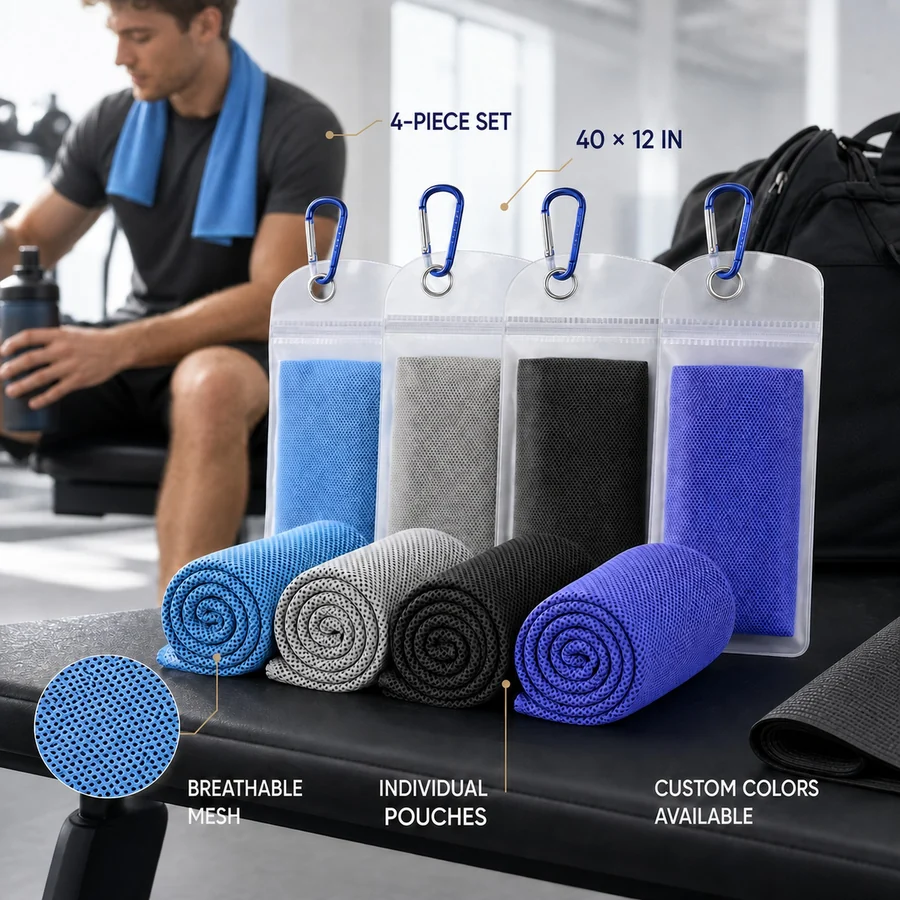
This guide gives sports brands, event organizers, retailers, and promotional-program buyers a practical brief they can send to a manufacturer. It uses a four-piece HENRY cooling-towel set as a reference configuration, not as a fixed specification. Final materials, performance, MOQ, packaging, and production details remain subject to design review, sampling, and final approval.
The eight decisions at a glance
| Decision | What to define before sampling | What should remain conditional |
|---|---|---|
| 1. Program use | User, setting, distribution channel, pack quantity | Any performance outcome not yet tested |
| 2. Towel format | Length, width, edge shape, folding or rolling method | Final production tolerance |
| 3. Material direction | Construction, hand feel, weight target, color direction | Final composition and tested performance |
| 4. Color system | Single-color or coordinated set, artwork references | Production color after lab dip or sample approval |
| 5. Branding | Method, size, location, orientation, artwork file | Exact result before process testing |
| 6. Pouch and attachment | Pouch material, closure, ventilation, clip type and position | Component specification and durability |
| 7. Packout | Pieces per set, individual or shared storage, retail or bulk presentation | MOQ and final packaging structure |
| 8. Acceptance plan | Dimensions, appearance, logo, pouch, attachment, labeling | Test limits not yet agreed in writing |
1. Start with the program, not the fabric
First define who receives the set and how it will be used. A four-piece retail set, a team kit, a race-event giveaway, and a travel bundle can use the same general towel shape but need different colors, branding, storage, labeling, and packout.
Your brief should answer four questions:
- Who is the intended user?
- Where will the towel be carried or stored?
- Is each towel distributed separately or as a coordinated set?
- Is the commercial goal retail presentation, team issue, event distribution, or private-label resale?
This decision controls the rest of the specification. For example, individual pouches and clips may be useful when every towel needs its own portable storage. A shared pouch may be simpler when the set stays together. Neither choice is automatically better; it depends on the program.
2. Define the towel format in measurable terms
Do not specify only “long cooling towel” or “sports towel.” Record a reference length and width, the intended fold or roll, edge shape, and any hanging or attachment point.
The featured HENRY four-piece set uses a 40 x 12 inch reference format. That long, narrow proportion can be a useful starting point for neck-wrapping and portable active-use concepts, but it is not a universal production standard. Your manufacturer still needs the target dimensions, acceptable tolerance, and the way the towel should fit inside its pouch.
Ask the sample team to check the towel and pouch together. A towel that meets its flat dimensions may still be awkward to roll, insert, remove, or repack.
3. Separate material direction from unverified performance
A useful RFQ describes the construction you want without turning an untested target into a public promise. Include:
- intended textile construction or mesh direction;
- target hand feel and thickness range;
- weight or GSM target when known;
- edge finishing and label preference;
- color and print compatibility;
- the performance questions the sample must answer.
Avoid treating words such as “cooling,” “quick-dry,” or “breathable” as complete technical specifications. The featured product direction uses a thin mesh structure, while final composition, weight, cooling behavior, absorbency, colorfastness, and wash durability require confirmation through the agreed sample and production specification.
If a quantified claim matters to your sales channel, define the test method and acceptance threshold before using that claim. Without an approved test plan and current evidence, keep the wording conditional.
4. Build a color system for the set
For a multi-piece program, decide whether the towels should be identical, tonal, or deliberately mixed. Provide color references and identify which elements must coordinate:
- towel body;
- edge binding or stitching;
- logo or label;
- pouch;
- clip or attachment;
- outer pack or insert card.
The current HENRY product reference shows a coordinated multi-color set, but exact alternative production colors are not frozen as approved options. New colors must therefore be treated as custom development subject to artwork review, sampling, MOQ, and final specification—not as guaranteed stock variants.
5. Choose branding by construction, not preference alone
Logo size and placement should follow the towel construction and intended viewing distance. A process that looks strong on a thick terry towel may not suit a thin mesh format in the same way.
Send vector artwork when available and specify:
- branding method to evaluate;
- finished logo dimensions;
- placement from a fixed edge;
- one-sided or two-sided visibility;
- orientation when the towel is folded, worn, or packed;
- acceptable color variation and artwork simplification.
HENRY can evaluate printing, embroidery, woven labels, or approved patches depending on the fabric and program. The final method should be confirmed on the actual sample. For a deeper comparison, see the custom towel logo methods guide.
6. Specify the pouch and attachment as product components
In a portable set, the pouch and clip are not afterthoughts. They affect pack size, presentation, handling, and the user’s ability to store each towel.
The featured four-piece cooling sports towel set pairs every towel with an individual pouch and carabiner clip. If that structure fits your program, define the pouch material direction, dimensions, opening, ventilation concept, artwork area, clip color, clip position, and how the towel should be inserted.
Do not assume component durability from appearance. Clip strength, pouch seams, closures, and repeated packing should be reviewed against the approved sample and any written acceptance method.
7. Freeze the packout before quoting the final program
“Four-piece set” can describe several different packouts:
- four towels in one shared pack;
- four individually pouched towels inside one outer pack;
- four separate retail units grouped for shipping;
- a mixed-color team or event kit;
- a custom number of towels derived from the same platform.
State the pieces per set, color ratio, individual storage, labels, inserts, barcode responsibility, carton assumptions, and whether the presentation is retail-ready or bulk. Final MOQ and packaging structure should be confirmed only after the manufacturer reviews the complete specification.
8. Write the sample acceptance checklist before the sample arrives
A sample is easier to approve when the buyer and manufacturer agree on what will be checked. At minimum, record:
- finished towel dimensions and visual tolerance;
- color comparison method;
- logo size, position, orientation, and legibility;
- stitching, edge finish, and visible defects;
- pouch fit, opening, and artwork;
- clip type, attachment position, and operation;
- set count, color ratio, labels, and packout;
- any agreed material or performance test with its method and limit.
Photograph the approved configuration and keep the signed specification with the order record. For a broader quality framework, use the custom sports towel inspection checklist.
A copy-ready RFQ block
Use this short block as the first page of your inquiry, then attach artwork and reference files:
Project: Custom cooling towel set
Use and channel: [team / event / retail / travel / promotion]
Pieces per set: [quantity and color ratio]
Towel size: [length x width and tolerance target]
Material direction: [construction, hand feel, weight target, finish]
Branding: [method to evaluate, size, position, artwork file]
Pouch: [individual/shared, material, size, closure, artwork]
Attachment: [clip or loop type, color, position]
Packout: [retail/bulk, label, insert, barcode responsibility]
Sample checks: [visual, dimensional, component, and agreed tests]
Target quantity and market: [for MOQ and specification review]
Common specification mistakes
Treating a reference image as the full specification
A photo can communicate direction but usually cannot freeze dimensions, composition, construction, logo process, component grade, or acceptance limits. Use it as evidence, then translate it into written fields.
Showing unverified colors as available stock
If a color is not confirmed in the current product record or sample, describe it as conditional custom development. This keeps the public offer aligned with what production can actually approve.
Approving the towel but ignoring the set
Check the towel, pouch, clip, labeling, color ratio, and outer presentation together. A multipack is only complete when those parts work as one commercial unit.
Publishing performance language before testing
Keep unverified material, cooling, absorbency, durability, or wash claims out of public copy. Convert important claims into sample questions and agreed tests first.
Custom cooling towel set FAQ
Is 40 x 12 inches the required size for a custom cooling towel?
No. It is the verified reference size for the featured four-piece HENRY concept. A custom program can evaluate other dimensions subject to design review, sampling, MOQ, and final specification.
Can every towel have its own pouch and clip?
Yes, that is the structure shown in the featured four-piece reference. Pouch dimensions, material, artwork, closure, and clip details still need to be confirmed for the custom sample.
Can we request several colors in one set?
You can propose a coordinated color plan. Production colors are conditional until the design, sample, MOQ, and final specification are approved.
Which logo method should we use?
The answer depends on the textile construction, artwork, size, placement, and desired appearance. Evaluate the method on the actual material rather than approving it from a generic mockup.
What should we send to receive a useful quotation?
Send the intended use, target quantity, towel dimensions, material direction, colors, artwork, branding placement, pouch and clip requirements, packout, market, and sample acceptance priorities. Unknown fields can remain open, but they should be labeled as decisions for development—not silently assumed.
Plan the set before the sample
A strong cooling-towel brief makes every open decision visible. Start with the user and pack role, then freeze the towel, color, branding, pouch, attachment, packout, and acceptance plan. HENRY can use that brief to review feasibility and prepare a made-to-order development path.
Explore custom cooling towels or send your specification for review.
Sources and product references
- HENRY GOOD, Custom 4-Piece Cooling Sports Towel Set with Pouches, product configuration and conditional customization scope, accessed August 2, 2026.
- HENRY GOOD, Custom Towel Logo Methods, branding-process decision guidance, accessed August 2, 2026.
- HENRY GOOD, Custom Sports Towel Inspection Checklist, sample and inspection planning guidance, accessed August 2, 2026.