Direct answer: For a custom rolling duffel, request separate measurements for the fabric body, the complete bag with wheels fitted, and every intended expansion state. Record whether the pull bar is removed, retracted or extended. A single height or size label cannot communicate all of those configurations.
Start with the configuration the buyer will actually receive. Then identify which measurements describe its external envelope and which describe the space available for the intended contents. This guide is for private-label buyers preparing dimensional information, not for deciding transport acceptance or making a capacity claim.
Separate three questions before comparing quotations
First ask, “How much space does the complete bag occupy?” Measure its outermost points in the agreed configuration. Second ask, “What are the dimensions of the body alone?” Record that answer separately, with removable components identified. Third ask, “What can the bag accommodate?” Answer with an agreed contents layout and a sample review rather than treating an external size as an internal measurement.
When comparing supplier responses, check the measurement boundary before comparing the numbers. Two heights can both be correctly measured yet describe different assemblies. Ask the supplier to mark the measured endpoints on photographs or a drawing and use the same labels in the quotation.
Give each expansion state its own entry
Avoid describing the entire system only as “small to large.” Name the closed, intermediate and fully expanded states that the proposed construction actually has. Do not invent an intermediate measurement by averaging the two endpoints.
For each state, record:
- Which expansion sections are open and which are closed.
- The bag orientation and the agreed measurement points.
- External length, width and height, with a unit beside each value.
- Whether wheels and the pull-bar assembly are installed.
- Whether pockets are empty and whether the body is empty or contains an agreed reference load.
- The photograph or drawing showing that exact configuration.
These are fields to agree during development, not predetermined values. If one state has not yet been measured, leave it as an open specification question. Do not carry a dimension from another bag into the blank.
Use a product reference without turning it into a universal specification
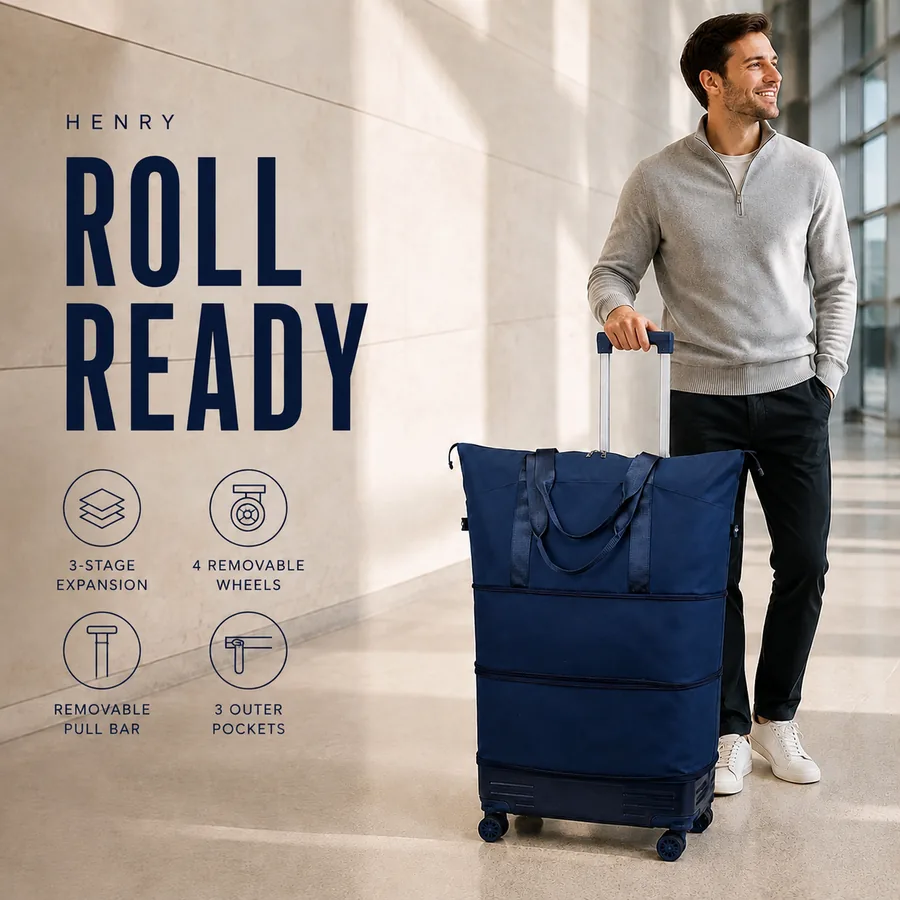
The HENRY expandable rolling travel duffel is a relevant example because its published configuration has three-stage expansion, four removable spinner wheels and a removable pull bar. The catalog gives a reference height direction of 15.73 to 29.11 inches.
Those endpoint heights do not, by themselves, supply all three-dimensional measurements for every assembly state. For a quotation, ask which measurement includes the wheels, where the endpoints are taken and what the intermediate configuration measures. The product reference starts that discussion; it does not replace the final dimensional drawing.
Its removable-component layout also makes a separate component list useful. Specify which wheels and pull-bar pieces are supplied with each bag and how they are presented in the agreed packout. A photograph of an assembled bag is not a complete packing list.
For the lining, base insert and other parts behind the exterior, use the materials-and-hardware guide's component checklist to name each agreed construction. Those headings support the component list; they do not select materials or dimensions for this rolling bag.
Record the pull bar separately from bag height
Use distinct labels for the complete bag height and the pull bar's operating positions. “Handle up” is too imprecise for a drawing that several people need to use. Identify the lowest and highest points being measured and show the intended bar position.
Where the pull bar is removable, request a second view showing the bag without it. Where wheels are removable, show whether their attachment features remain on the base. Record what stays attached; do not assume that removing a wheel removes every projection at that location.
Keep these dimensional records separate from any requirement for component operation. This guide defines what is being measured and shown, not a tested rating for the assembly.
Describe contents without inventing a litre figure
If the buyer needs space for a particular kit, list its actual items and dimensions. Show the proposed arrangement and identify any item that must pass through a particular opening. The usable opening and the internal arrangement are separate questions from the outer dimensions.
Do not convert a set of outside measurements into a promised capacity. Instead, request the supplier's capacity definition and measurement method if a volume figure is needed. Keep the final agreed capacity field separate from the dimensional schedule and packing demonstration.
For a broader brief covering drawings, materials and decoration, use the gym-bag tech-pack checklist as supporting context. Its general document structure does not determine the rolling bag's dimensions.
Make the dimensional handoff easy to review
Prepare a short drawing set rather than a page of unlabeled numbers. Include front, side and base views, plus a view for each expansion state. Use one unit system as the working reference and identify any conversions as conversions. Ask the supplier to confirm the working values before sampling.
Attach a component list and a description of the intended delivered configuration. State whether detached items should be placed inside the bag or packed separately, subject to the agreed design. Confirm the packaged dimensions only after that configuration has been reviewed.
Finally, give the sample and drawing the same revision reference. When a dimension or component changes, identify the affected views and ask for a revised sample or confirmation as appropriate. This is a document-control recommendation, not an assurance that every design change can be accommodated.
Frequently asked questions
Should a rolling duffel height include the wheels?
The label must say. For the complete external envelope, measure the assembly with the specified components fitted. Also record body-only dimensions when the project needs them; do not mix those two measurement boundaries.
Can the middle expansion size be calculated from the endpoints?
Do not assume it. Ask for the actual intermediate configuration, its open sections and measured dimensions. The endpoint range alone does not define that state.
Does an exterior size establish usable capacity?
No. Record the internal arrangement and opening requirements separately. If a capacity figure is required, ask for its definition and measurement method rather than deriving a promise from outside dimensions.
What should accompany a custom rolling-duffel inquiry?
Send the intended use, dimensioned views for each required state, component list, delivered configuration, artwork and quantity. HENRY reviews development options subject to design review, sampling, MOQ review and the final written specification.