Direct answer: Start with the exact guitar model and a dimensioned outline of the actual instrument. Record overall length, body length, upper- and lower-bout widths, waist width, body depth and the headstock envelope. Then ask for the proposed bag's usable internal measurements at the corresponding locations.
A “40/41-inch” size direction is not a complete fit specification. For a private-label gig bag, the useful result is a matched instrument-and-bag drawing set, followed by a sample review of insertion, closure and the intended accessory arrangement.
Establish the instrument reference first
Name the intended model and version, and state whether the programme covers one instrument or several. If more than one model is included, measure each separately. Do not assume that models with similar overall lengths have matching body outlines.
Choose a consistent orientation for the reference photographs. Include a full front view and a side view, with measurement endpoints visible. Keep any maker's published dimensions as a separate source record and reconcile differences against the actual reference instrument before approving the brief.
For a range of instruments, request an explicit list of models covered by each proposed bag pattern. A single sample should not silently stand in for unmeasured models.
Measure the outline, not just the longest dimension
Use a measurement sheet organised around identifiable locations:
- Overall length: mark the two endpoints used for the full instrument.
- Body length: identify where the body measurement begins and ends.
- Upper bout and lower bout: record the width at each named section.
- Waist: record the narrower body section and its position along the outline.
- Body depth: show the measured location in the side view.
- Headstock envelope: document its width, length and profile, including protruding tuning hardware.
- Other projections: identify strap buttons or other fitted parts that affect the intended enclosure.
Do not assign universal extra clearance in this first sheet. It should describe the instrument, not an invented bag allowance. Ask the supplier to propose the internal pattern dimensions and explain where additional space is intended.
Match each instrument measurement to an internal bag location
Ask for an internal bag drawing that uses the same reference locations as the instrument sheet. A maximum interior width elsewhere in the bag is not a substitute for the width where the lower bout will sit.
Record whether the interior was measured with the lining and padding relaxed, compressed or in another agreed condition. The method needs to be repeatable between the drawing and the sample review. Do not infer usable space from a photograph of the closed exterior.
Keep padding thickness, lining construction and internal fit dimensions as separate fields. Changing one may require the others to be reviewed. Keep the dimensional fit record separate from the rest of the programme specification.
The materials-and-hardware guide's lining and padding checklist is a useful companion for naming those construction fields. Apply it to the proposed gig bag without treating another bag's construction as an approved specification.
Treat an existing product as a layout example
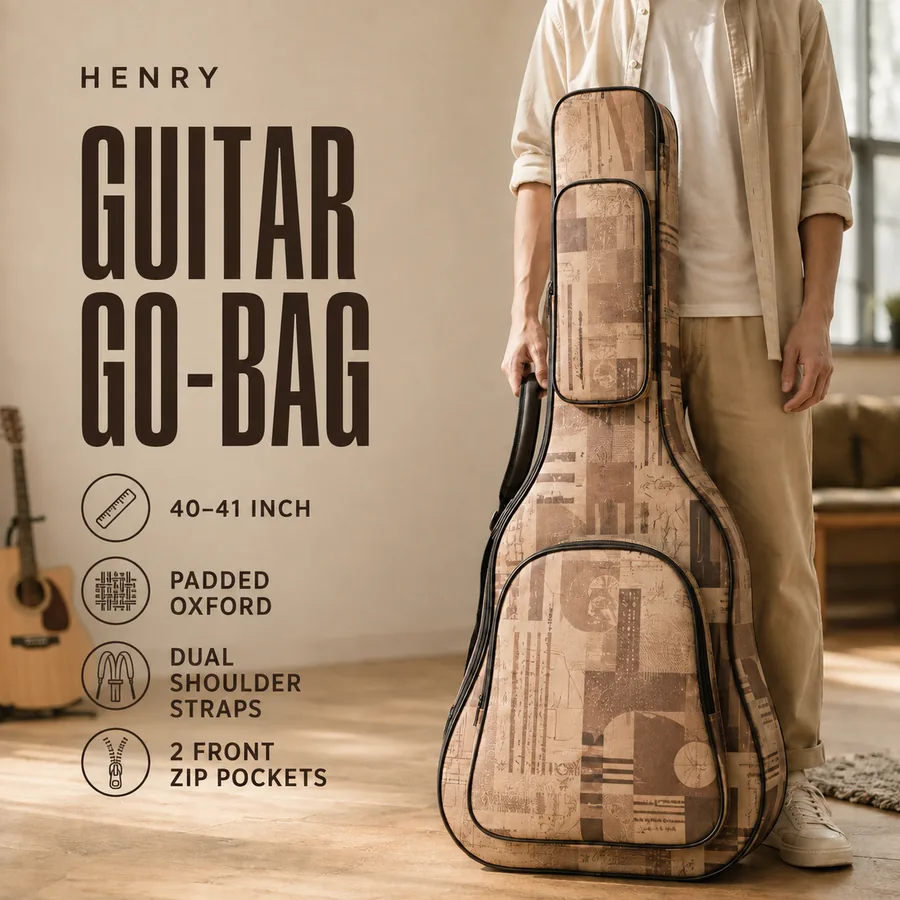
The HENRY padded guitar gig bag provides a published 40/41-inch direction with an Oxford exterior, dual shoulder straps and two front zip pockets. Its product page explicitly leaves exact instrument-fit dimensions for confirmation against the intended guitar.
That makes it a useful starting layout for a private-label discussion, not proof that a particular instrument fits. The reference does not provide a universal interior allowance. Bring the instrument sheet to the inquiry and ask which dimensions, padding and lining details would need to be resolved in development.
The current product image illustrates that bag layout. It is not a scaled drawing, and its background instruments should not be treated as verified compatibility examples.
Check the opening and accessory arrangement separately
An internal cavity and an access opening are different parts of the brief. Record how the guitar is intended to enter the bag and what zip opening or panel arrangement is being proposed. Review the complete sample using the agreed instrument reference and supplier instructions.
For front pockets, list the actual accessories intended for each one. Record the required pocket opening and usable space, then show the proposed packed arrangement. Do not copy a pocket dimension from an unrelated bag simply because the product photograph looks similar.
Include the intended strap and handle layout in the drawing set. Keep any separate functional evaluation outside the dimensional fit record. Avoid treating a dimensional review as a broader product-performance sign-off.
Review the sample against the same drawing
Use the tech-pack guide's drawing and point-of-measure section to organise views and dimension labels. It supplies a document structure, not guitar-specific measurements or a fit allowance.
Begin with the agreed reference instrument and the current drawing revision. Confirm that the sample being reviewed is the corresponding revision. Compare the internal locations, opening arrangement and pocket layout with the submitted brief.
Record observations in plain terms: where the instrument sits, where extra room remains, and which dimensions or construction details need clarification. If the sample does not close as intended, ask for a pattern review rather than silently accepting a different fit method.
After a proposed change, update the affected measurements and views. Ask the supplier to confirm whether a revised sample is needed before the design is accepted. Keep the instrument model list, bag drawing and final sample identification together.
Frequently asked questions
Is a 40/41-inch label enough to order a custom gig bag?
No. Use it only as a size direction. Exact instrument dimensions, the proposed internal outline and a sample review are needed to define the intended fit.
Should I submit interior or exterior measurements?
Submit the instrument's dimensions first and ask for the bag's usable interior dimensions at corresponding locations. Exterior bag measurements are useful for a different purpose and should be labelled separately.
How much extra clearance should I specify?
Do not assume one allowance suits every outline or construction. Ask the supplier to propose clearances against the instrument drawing, padding and lining, then review the intended fit on a sample.
Can one sample establish fit for several guitar models?
Only the models actually included in the agreed review are covered by that review. Provide separate model references and measurements, and ask for an explicit compatibility scope instead of generalising from one instrument.