An organizer set is not one product repeated in several sizes. It is a coordinated system of cubes, pouches and specialty bags that must work together in materials, colour, labels, closures and packaging. Buyers can prevent most sample confusion by approving the set as a matrix rather than commenting on one piece at a time.
The HENRY eight-piece travel organizer reference combines three garment cubes with five specialized organizers. This checklist helps private-label buyers turn that reference direction into a controlled project brief.
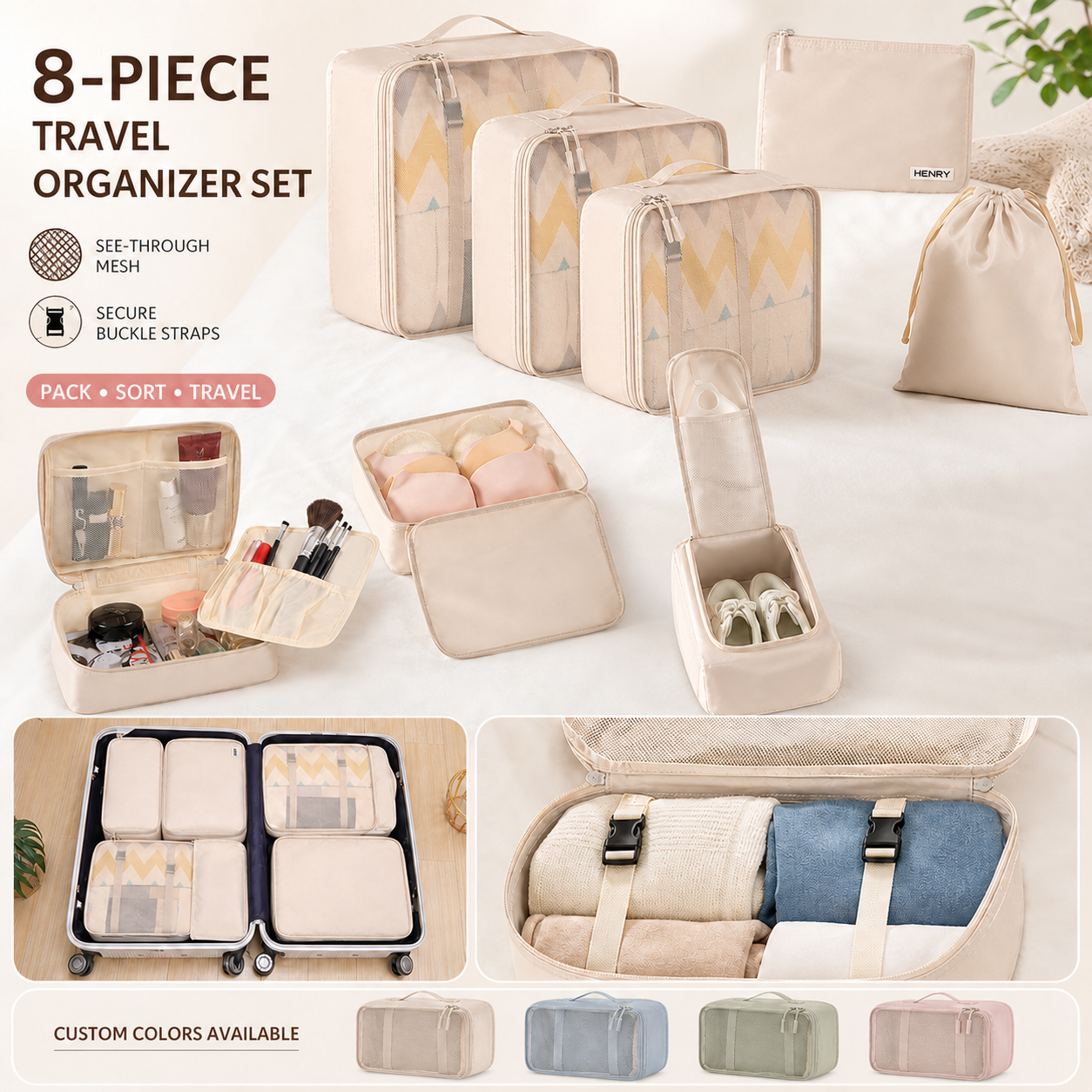
Create a piece-by-piece matrix
Give every component a stable code. Record its finished dimensions, intended contents, fabric, mesh or window area, zipper, handle, label and quantity per set. A simple matrix prevents comments such as “make the small bag wider” from being applied to the wrong piece.
Include a set diagram showing how the components relate. If dimensions must fit a specific suitcase or carton, record that constraint before the sample is built.
Define shared and unique components
Decide which details must match across all pieces: body fabric, lining, zipper tape, pullers, thread, binding and logo method. Then mark exceptions, such as a shoe pouch that needs a different panel or a laundry bag that uses another closure.
Do not rely on “same as the cube” when construction differs. Each exception should have its own specification line.
Review visibility and access
Mesh panels can help identify contents, while opaque sections provide privacy. Check mesh placement, opening direction and how the component behaves when full. Confirm that handles and zippers remain accessible when pieces are packed together.
Any airflow or moisture-performance statement should remain conditional until the final construction and an agreed test method support it.
Approve dimensions in use
Measure each item empty and pack it with representative contents. Check whether the set still follows the intended luggage plan. Record the measurement method and tolerance in the final specification rather than relying on a visual comparison.
Control colour and branding
Assign component-level colour references for body fabric, mesh, binding, zipper and thread. Custom colour development depends on material availability, sampling, MOQ and final specification. Approve branding on the assembled pieces, including the smallest component.
Check closure and handle consistency
Operate every zipper, drawcord, buckle or hook. Compare puller orientation and handle placement across the set. A coordinated appearance matters, but the closure must also suit the way each piece is filled and carried.
Approve the complete packout
Review the set count, stacking order, insert card, labels, barcode position and outer packaging. Take one photograph of the complete open set and one of the final packed unit. These become useful references for later inspections.
Record revisions by component code
Number each change and name the affected component. Keep approved measurements, artwork and packaging linked to the same sample version. When the final sample is signed, archive earlier versions and provide the supplier with one controlled approval list.
Frequently asked questions
Should every organizer use the same material?
Not necessarily. Shared materials simplify coordination, but a specialized pouch may need a different construction. Record every exception explicitly.
How should set dimensions be approved?
Measure each component using an agreed method, then pack representative contents and verify the complete luggage and packaging plan.
Does mesh guarantee faster drying?
No universal performance result should be assumed. Mesh is a construction direction; drying or airflow claims require the final design and an agreed test method.
What should be photographed at approval?
Photograph each coded component, the complete open set, important construction details and the final packed unit.
Source and product reference
- HENRY GOOD, Custom 8-Piece Travel Packing Organizer Set, verified three garment cubes and five specialized organizers with conditional customization scope, accessed August 16, 2026.