Direct answer: Specify the chair before you specify the towel cover. Start with the exact lounge-chair model and a measurement sheet, then freeze the finished cover dimensions, fitted-pocket depth, side-pocket layout, attachment method, carry-fold requirement, material, artwork and packout. Treat every published product as a construction reference, not as a universal specification. A sample should confirm the chosen combination before production details are finalized.
This approach matters because structures that look similar can be materially different. Current HENRY references include fitted top pockets, twin side pockets, base ties, six separate clips, two lower loops and carry-fold formats. They also span microfiber and cotton-terry references and several finished dimensions. Those fields should be selected deliberately rather than copied as a bundle.
Start with a chair measurement sheet
Use the actual chair model that the project will serve. Record the overall usable length and width, the top and lower backrest widths, backrest thickness where a pocket will sit, and any location where a tie, clip or loop is expected to attach. Photograph the chair from the front, back and side, and give every image the same chair-model reference.
The finished towel-cover dimensions and the pocket dimensions are separate fields. A long towel does not automatically define the depth or opening width of its fitted pocket. Likewise, a pocket depth taken from one chair model should not be transferred to another without a fit check.
If a resort uses more than one chair model, list them separately. The sample brief should state whether one cover is expected to fit all listed chairs or whether different dimensions will be developed. Do not hide that decision inside a general phrase such as “standard lounge chair.”
Compare the three main structure directions
| Structure direction | Verified HENRY references | What to freeze in the brief | Important limitation |
|---|---|---|---|
| Fitted top pocket with a simpler long cover | A 26 × 82 in terry-cotton reference has an 8 in top pocket; a two-piece 32 × 82 in ringspun cotton-terry set has a 7 in top pocket | Finished length and width, pocket depth, pocket opening width, material and whether the project is a single item or a set | The two pocket depths and cover widths are reference facts, not interchangeable standards |
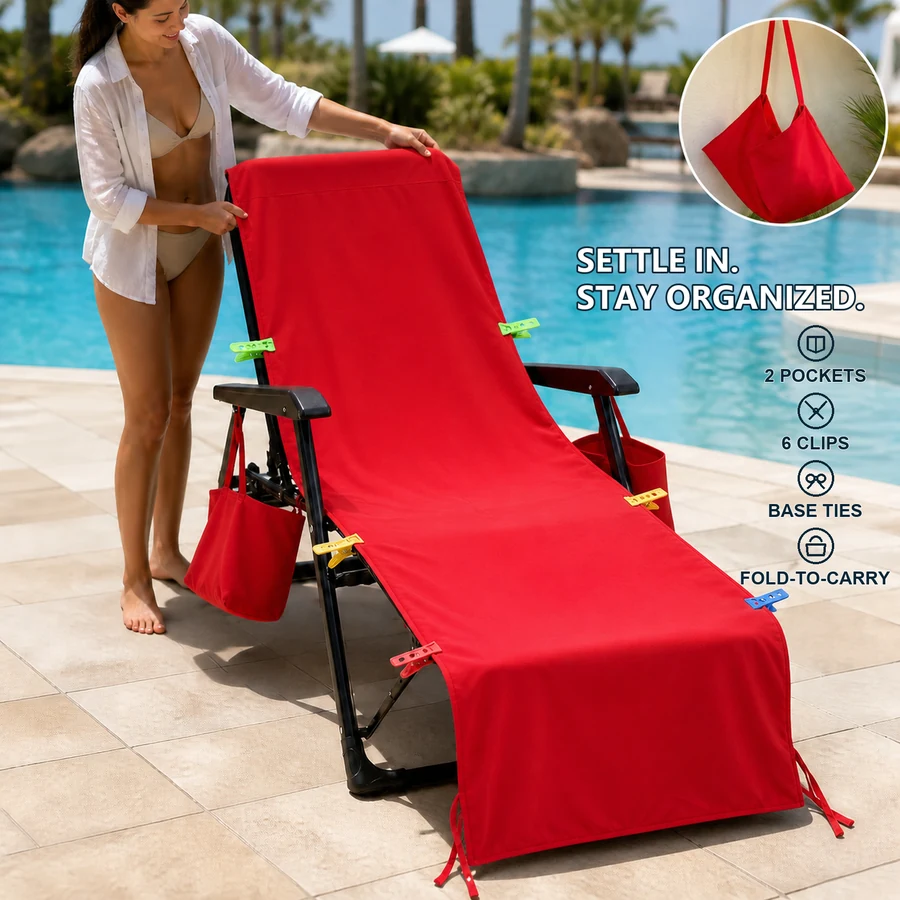
| Top pocket, two side pockets, base ties, six clips and carry-fold construction | Both an 85 × 30 in red reference and an 85 × 30 in microfiber reference use this feature set | Side-pocket position and opening, tie location, exact clip count and placement, folded state and carry details | The presence of ties and clips does not establish holding strength or fit on an unmeasured chair |
| Top pocket, twin side pockets, two lower loops and carry-fold construction | One fitted reference uses exactly two lower loops with twin side pockets and a shoulder-carry folded state | Loop count and location, side-pocket orientation, fold sequence, strap details and final chair fit | Lower loops are a different construction choice from six separate clips or base ties |
For a visual reference to the simplest fitted-pocket direction, see the 26 × 82 in gray-stripe cotton lounge-chair cover. For a multi-feature direction, compare the 85 × 30 in red cover with pockets, ties and six clips with the fitted cover using twin pockets and two lower loops. These are examples of different architectures, not a ranking.
Define the fitted top pocket as its own component
A fitted top pocket wraps over the chair backrest. The specification should identify the pocket depth, opening width, finished shape and stitch boundary. State whether the pocket is cut from the same material as the main towel cover and how the printed or striped face should align when the cover is installed.
Current references show why the field must be explicit: one cotton-terry set uses a 7 in pocket, while a separate gray-stripe terry-cotton reference uses an 8 in pocket. Neither number should become a default for a new chair. Confirm the measurement against the selected chair and then check it on the sample.
Place side pockets around actual use
“Two side pockets” is not a complete instruction. Define whether one pocket sits on each side, their finished size, opening direction, vertical position and orientation while the cover is installed. The brief should also show whether the pockets remain visible in the carry-fold state or are folded inside.
Do not turn a visual pocket into an unsupported load or capacity claim. A sample review can record dimensions, access and construction. Any separate performance requirement needs its own agreed method and acceptance rule before it becomes part of the specification.
Keep ties, clips and lower loops separate
Ties, clips and sewn loops are different parts. List them on separate rows in the bill of materials or construction sheet.
- Base ties: record the quantity, material, finished length and exact anchoring points.
- Separate clips: record the physical count, clip style, attachment point and supplied packout. Two verified 85 × 30 in references include six clips.
- Lower loops: record the physical count, finished loop size and placement. One verified fitted reference uses exactly two lower loops.
This separation prevents a quotation or sample from treating “attachments included” as permission to substitute one method for another. It also makes the sample review straightforward: count the parts, compare their location with the drawing and record any mismatch.
Specify carry-fold construction only when it is required
Some verified references fold into a shoulder-carry state. If that function belongs in the project, include a separate folded-state drawing or sequence. Freeze the orientation of the pockets after folding, the strap or handle arrangement, the closure if one is used, and the intended packed presentation.
Carry-fold should not be assumed for every lounge-chair towel cover. It adds a second physical state that must be checked on the sample alongside the installed chair-cover state. A useful approval record includes photographs of both states and notes any feature that becomes inaccessible, reversed or misaligned after folding.
Freeze material and dimensions without borrowing claims
The current catalog contains both microfiber and cotton-terry lounge-chair cover references. Verified cotton examples include 100% ringspun cotton terry and 100% terry cotton. Material naming alone does not complete a new project specification. The final construction, weight, colour, edge, labels and decoration need written confirmation for the selected design.
The current dimension references also differ: 85 × 30 in (215 × 75 cm), 32 × 82 in and 26 × 82 in. Use them to understand possible proportions, not as evidence that one size fits a resort’s chairs. Freeze dimensions in one primary unit system, add the converted values if useful, and state the allowed method for checking the finished sample.
Artwork is another independent decision. Select a decoration route only after confirming the material and visible print or embroidery area. The custom towel logo and printing methods guide can help frame that discussion, but the approved artwork, colour references and placement drawing still belong in the project file.
Build a sample-ready resort brief
A practical brief can be organized into eight blocks:
- Chair schedule: chair-model names, measurements and labelled photographs.
- Finished cover: length, width, shape, edge construction and measurement points.
- Top pocket: depth, opening width, alignment and stitch boundary.
- Side storage: number, side, size, opening direction and installed position.
- Attachments: separate counts and locations for ties, clips and lower loops.
- Carry-fold state: required or not required; if required, add the fold sequence, strap details and packed presentation.
- Material and branding: final material direction, colour references, artwork files, decoration area, labels and packaging.
- Sample record: measured results, photographs, accepted fields, revisions and items held for separately agreed testing.
Keep customization conditional. Material, colour, artwork, labels, packaging and construction changes remain subject to design review, sampling, MOQ confirmation and the final written specification. Browse the HENRY beach and resort towel range for additional format references, then use the custom towel inquiry to send the chair schedule and selected architecture.
Sample approval: compare evidence, not impressions
During sample review, place the cover on the exact chair model and compare every frozen field. Measure the overall cover and pocket, count each attachment, check pocket location, and photograph the installed and folded states where applicable. Record “accept,” “revise” or “separate test required” for each line.
An observation such as “six clips are present” is different from a performance result. Likewise, confirming that a pocket fits over one chair backrest does not prove fit on a different model. Keeping observations separate from unperformed tests gives the factory and buyer a clearer revision record.
Frequently asked questions
What measurements should a lounge-chair towel-cover RFQ include?
Include the actual chair model's usable length and width, backrest widths, backrest thickness at the pocket location and all intended attachment positions. Then list the cover's finished length and width and the fitted pocket's depth and opening width as separate fields.
Are ties, clips and lower loops interchangeable?
No. They are different physical components. Specify each type, count and location separately, and do not permit substitution unless it is reviewed and recorded in the sample revision.
Is a material name enough for quotation?
No. A material direction such as microfiber or cotton terry should be paired with the final construction, colour, edge, decoration, label and packaging requirements. Unverified properties should not be inferred from the material name.
When should carry-fold construction be included?
Include it only when the project requires a second folded carry state. Freeze the folding sequence, strap or handle details, pocket orientation and packed presentation, then approve both the installed and folded sample states.
The specification decision
Choose the smallest architecture that matches the documented chair and service brief, then freeze every selected component. A fitted top pocket, side pockets, ties, six clips, two lower loops and carry-fold construction are independent decisions. Dimensions and materials are independent decisions too. When the brief keeps those fields separate, a sample can verify the chosen product instead of forcing the buyer to interpret a generic reference after it arrives.